Nephrology Nursing Track · By Role · Module 7 of 18
Mid-Session Surveillance: Pressure, Cramps, Glucose, and the Patient Who Goes Quiet
Why pressure falls, the first response inside the protocol, cramps, low blood sugar during dialysis, the drowsy patient, and falls at disconnection.
PublishedNailathalaGipatikPepalwal:ReferencesMga SanggunianMga TinubdanReng Reperensya:8Audience: Experienced hemodialysis nurses who take charge of a shift · nurses being prepared for charge duty · head nurses and educators who orient themRead timeOras ng pagbasaOras sa pagbasaOras ning pamamasa:
This module is study material for charge nurses in hemodialysis units. It explains the reasoning behind common decisions; it is not a protocol. On the floor, follow your unit’s protocol and always ask the attending nephrologist for guidance. Doses, limits, and cut-off values are set by your unit. Every case is fictional.
Learning objectives
After this module you should be able to
Explain why blood pressure falls during dialysis in terms of removal rate and refill.
Recognize intradialytic hypotension by symptoms and by the definitions used in research.
Give the first nursing response to falling pressure and cramps inside the unit protocol, and know when to call.
Detect low blood sugar during a session in patients on insulin or sulfonylureas.
Notice the patient who goes quiet, and treat drowsiness as a finding until proven otherwise.
Prevent falls at disconnection and on the way out of the unit.
Pre-testBefore you read, answer the 8 self-assessment questions and note your score. After the module, select New set of questions and compare. The difference is what you learned; the questions you still miss are what to reread.
Start here
The big picture, in plain words
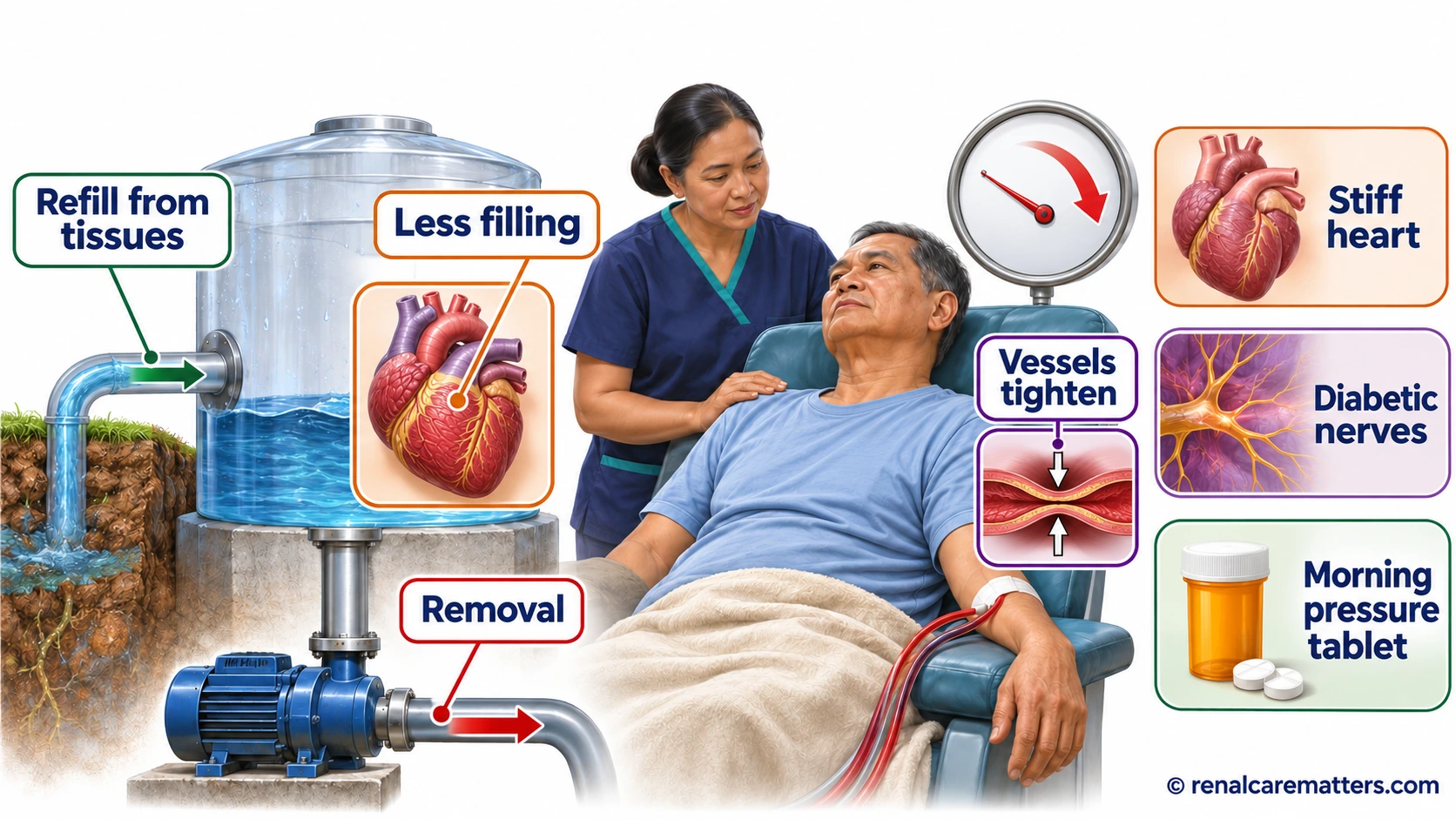
In plain wordsPicture a water tank drained from the bottom while a slow pipe refills it from the ground around it. If you drain faster than the pipe fills, the level drops, however much water is still in the ground.
The blood is the tank and the tissues are the ground. During hemodialysis (HD), the machine removes fluid only from the blood, and the tissues refill it at a limited rate; the speed of removal is the ultrafiltration rate (UFR). When removal outruns refill, blood volume falls, the heart has less to pump, and the vessels tighten to hold the pressure up. In many dialysis patients that defense is weak: a stiff heart, nerve damage from diabetes, or a blood pressure tablet taken that morning.1,2
The tank picture stops short of one thing. A falling pressure also lowers blood flow to the heart, the brain, and the gut, and repeated drops are associated with injury to the heart muscle.3 This is why the charge nurse watches the middle of the session as closely as its start.
Figure 1 · Key terms for this module
Intradialytic hypotensionA fall in blood pressure during dialysis that causes symptoms or needs nursing action.
NadirThe lowest systolic pressure in a session.
RefillMovement of water from the tissues back into the blood vessels.
HypoglycemiaLow blood sugar.
SulfonylureaA diabetes tablet that makes the pancreas release insulin, and can cause low blood sugar.
Post-dialysis fatigueTiredness after a session that can last hours.
Opening case · fictional
Case: “Lola is just sleeping”
Mrs. Felicidad Cruz, 79, has diabetes treated with insulin. She started dialysis at 6:30 with a pressure of 138/70 and a fluid goal of 2.8 liters on a dry weight of 48 kilograms. She took her usual morning insulin and skipped breakfast because the jeepney came early.
At 8:45, the assigned nurse charts “sleeping comfortably.” On his 8:50 round, the charge nurse, Ramon Aquino, finds her hard to rouse and sweaty. Her pressure is 92/50. The machine shows 1.6 liters removed.
Before reading on, decide:
What are the two most likely causes, and how do you tell them apart in two minutes?
What does Ramon do first, and what does he say to the physician?
What should have been caught at 6:15?
Keep your answers in mind. The lesson gives you what you need, and the case review near the end shows one sound response.
Lesson · part 1
Defining a fall in pressure
The European Best Practice Guideline (EBPG) defined intradialytic hypotension as a fall in systolic pressure of 20 mm Hg or more, or in mean arterial pressure of 10 mm Hg or more, with symptoms or a need for nursing action.4 In a large United States cohort, a nadir systolic below 90 mm Hg was the definition most strongly associated with death; for patients who started at 160 or more, a nadir below 100 was.5
Figure 2. Why pressure falls during dialysis: removal outruns refill, and many dialysis patients cannot compensate.
Use symptoms and numbers together. Yawning, cramping, nausea, dizziness, restlessness, or going quiet often come before the number falls. A patient who drops from 180 to 120 may be in more trouble than one who sits at 105 every session.
Lesson · part 2
The first response, inside the protocol
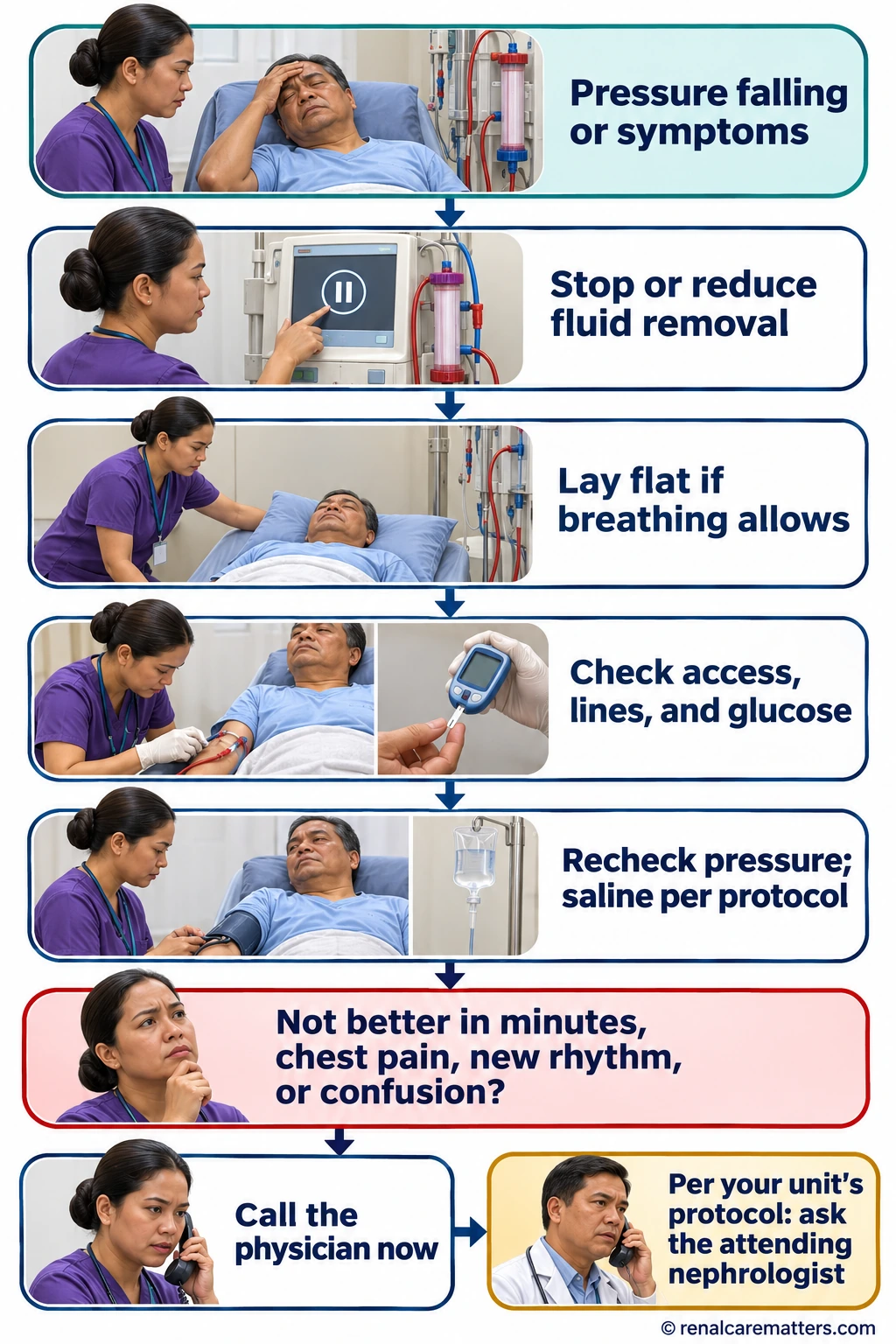
Most units’ protocols share a common first sequence. Follow yours; this is the logic behind it.
Figure 3. A first response to falling pressure inside the unit protocol, ending in a call.
Figure 4 · First response to falling pressure
Stop or reduce fluid removalThe cause is usually removal outrunning refill; stopping removal lets the tissues catch up.
Lay the patient flatLegs raised if breathing allows; this returns blood to the heart.
Check access, lines, and glucoseA disconnected line, bleeding, or low blood sugar can look the same.
Recheck pressure; saline per protocolGive the volume your protocol allows.
CallPer your unit’s protocol, and always ask the attending nephrologist for guidance.
Stop and callCall the physician now if pressure does not recover within minutes after stopping fluid removal and lying flat, or if there is chest pain, a new irregular pulse, confusion, breathlessness, or this is the second drop of the session. A drop that does not respond is something else until proven otherwise: a heart attack, an arrhythmia, bleeding, infection, or fluid around the heart.
Lesson · part 3
What does not work as hoped
Cooling the dialysate was expected to protect pressure and the heart. In the MyTEMP trial (Major Outcomes With Personalized Dialysate Temperature), 84 Canadian centers were randomized to a cooler-dialysate policy or standard temperature, and cardiovascular death or admission did not differ.6 Cooling may still help a particular symptomatic patient, as the attending decides; it is not a unit-wide fix.
The approach with the strongest logic is prevention: realistic fluid goals, longer or extra sessions when needed, and blood pressure tablets timed after dialysis rather than before (Module 5).
Lesson · part 4
Cramps
Cramps cluster in the last hour and on days with large fluid removal. They are associated with fast removal and low blood volume. The first response is to slow or stop fluid removal and stretch the muscle; further treatment follows the unit protocol. A patient who cramps every session needs the fluid plan reviewed, not just more saline every time.
Lesson · part 5
Low blood sugar during dialysis
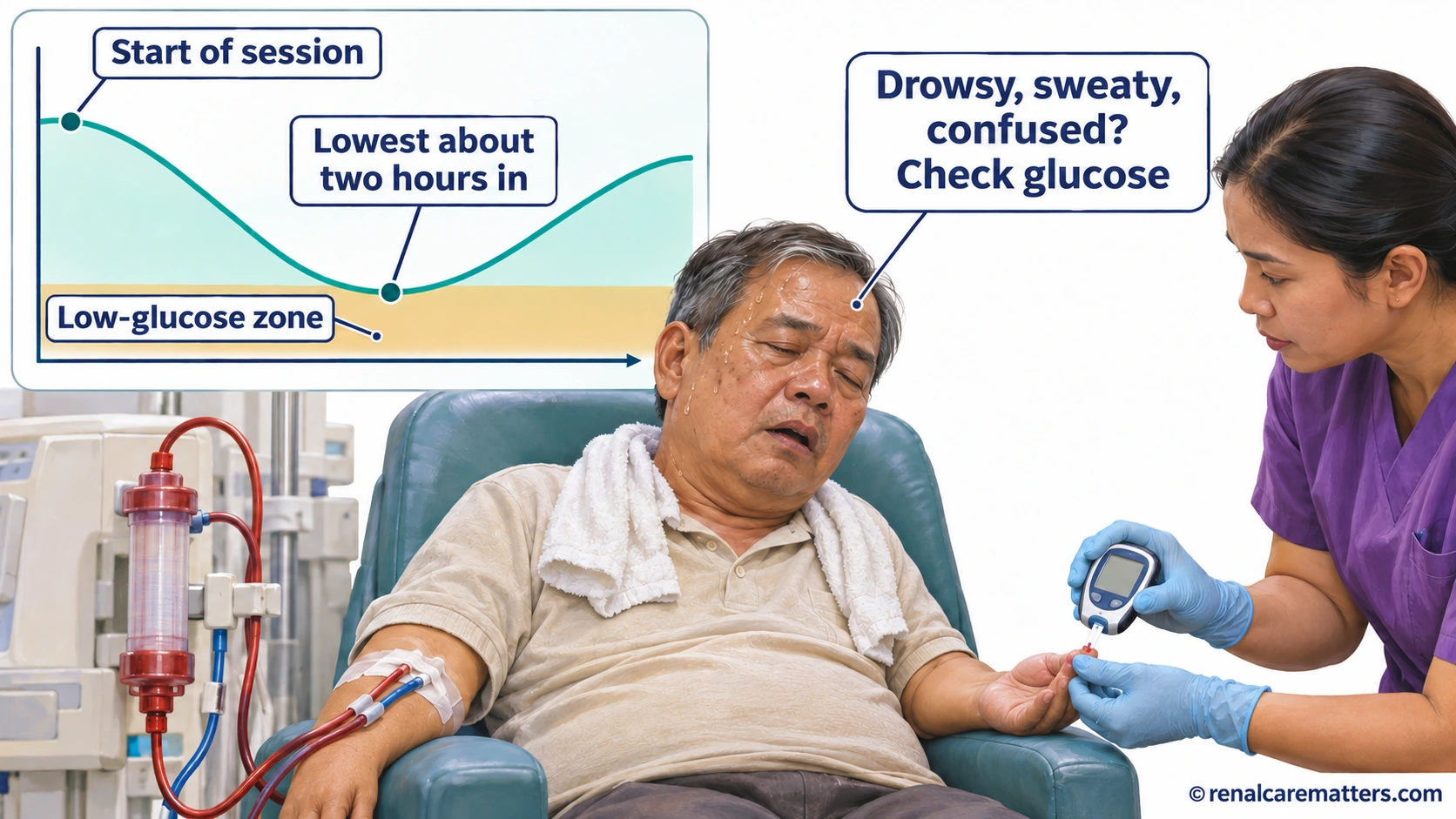
Glucose falls during dialysis, and the fall can be steep. In a 2026 study that used continuous glucose monitoring in 40 adults with insulin-treated diabetes, mean glucose fell 32% during dialysis, reached its lowest point at about 125 minutes, and 20% of participants had low blood sugar during a session.7 It was a small observational study, but the pattern is clear and fits what nurses see.
Figure 5. Glucose dips during dialysis, lowest about two hours in. A drowsy, sweaty patient on insulin needs a fingerstick.
Low blood sugar looks like low pressure: sweating, confusion, drowsiness. Check a fingerstick glucose whenever a patient on insulin or a sulfonylurea becomes drowsy, sweaty, or confused, whatever the pressure shows. Treat per protocol and tell the physician.
RememberDrowsy plus diabetes medicine equals a fingerstick, before you decide it is only the pressure.
Lesson · part 6
The patient who goes quiet
“Sleeping comfortably” is one of the most dangerous entries on a dialysis chart. Drowsiness during a session can be ordinary tiredness, or it can be low pressure, low blood sugar, high potassium, a stroke, or low oxygen. Rouse every patient at every round. If you cannot rouse someone easily, treat it as an emergency (Module 12).
Tiredness after dialysis is common, which is exactly why a sleepy patient is easy to dismiss. A meta-analysis of twelve studies found a pooled prevalence of post-dialysis fatigue of 61%.8 Most sleepy patients are only tired. The rule exists for the few who are not.
On the floor · The man who would not wake
On a 10:00 round, Nurse Ana Villareal finds Mr. Lito Bautista, 66, asleep with his mouth slightly open. She touches his shoulder; he does not open his eyes. She says his name louder; he mumbles. His pressure is 118/70, the same as at the start. His glucose is 104. She notices the left side of his face droops. She stops the session per protocol, calls the physician on duty, and the patient is transferred for stroke assessment. If she had charted “sleeping,” the window for treatment might have closed.
Illustrative scenario. Names and details are invented.
Lesson · part 7
Falls at disconnection
After the session, sit the patient up slowly, check standing pressure if your protocol asks, and walk beside anyone with a history of falls, a low post-dialysis pressure, or a new blood pressure medicine. The riskiest moment is the first few steps toward the door, when pressure is at its lowest of the day.
On the floor
Real situations: problems and solutions
These are fictional but typical. For each one, cover the answer, decide what you would do, then compare. Where a step depends on local rules, your unit’s procedure and your supervisor’s direction come first.
The second drop
What you see
A patient’s pressure falls for the second time this session.
What is likely going on
The fluid plan does not fit today.
What to do
Call the physician; repeated drops mean the plan needs changing now.
Why it matters
Repeated drops are associated with heart injury.
“Finish my fluid in the last hour”
What you see
A patient asks for the remaining fluid to be removed faster.
What is likely going on
Catching up would push the rate far above safe levels.
What to do
Explain the risk and ask the physician. Do not raise the rate on your own.
Why it matters
The rate matters as much as the total.
The cramp that wants to stop everything
What you see
A cramping patient asks to come off now.
What is likely going on
Fast removal and low blood volume.
What to do
Slow or stop fluid removal and stretch first; reassess before agreeing.
Why it matters
Many cramps settle in minutes.
Field notes
Patient before pump.
Drowsy plus diabetes medicine equals a fingerstick.
“Sleeping” must be rousable.
Case review
Back to the case: “Lola is just sleeping”
Two likely causes. Low pressure from fast fluid removal, and low blood sugar from insulin without breakfast. Both make an older woman sweaty and hard to rouse. A two-minute check of pressure plus a fingerstick glucose separates them, or shows both.
The two minutes (Toolkit #c8). Her systolic fell from 138 to 92: 46 mm Hg, or 33%. Removed so far: 1.6 liters in 2 hours 20 minutes, 1,600 ÷ 2.33 ÷ 48 = 14.3 mL/kg/h, above 13. Ramon stops fluid removal and lays her flat in twenty seconds, and asks the second nurse for a fingerstick while he rechecks the pressure: glucose 52 mg/dL. He treats the low sugar and gives saline per protocol, then calls: “Mrs. Cruz, 79, took insulin and skipped breakfast, hard to rouse at 8:50, glucose 52, pressure 92/50 from 138, fluid removal stopped at 1.6 liters, rate was 14.3 mL/kg/h. Glucose treated, saline given. I need orders for the rest of the session and for her insulin.” At 9:00 she is awake, pressure 112/60, glucose 118.
What should have been caught at 6:15. Nobody asked about insulin and breakfast, and a fluid goal of 2.8 liters on a 48-kilogram patient over four hours implied a rate of 14.6 mL/kg/h. Both are pre-dialysis questions (Module 5). The fix is a standard question at the scale and a rule that any drowsy patient on diabetes medicine gets a glucose check.
Skills lab · with your preceptor
Skills checklist: Mid-session surveillance
A facilitator runs three simulated deteriorations: falling pressure, low blood sugar, and a patient who cannot be roused. A fourth station covers disconnection of a fall-risk patient. Your preceptor rates each step as satisfactory, needs practice, or not observed. Steps marked Critical must all be satisfactory before sign-off. This checklist supports supervised learning; your unit’s own procedure and competency form are the authority. A printable version of every checklist is on the trainer page.
States the EBPG definition and the nadir flags.
CriticalStops or reduces fluid removal and lays the patient flat within the first minute.
CriticalChecks access, lines, and glucose as part of the first response.
CriticalCalls the physician when pressure does not recover or red-flag features appear.
CriticalChecks glucose in a drowsy patient on insulin or a sulfonylurea.
CriticalRouses every patient on rounds and treats an unrousable patient as an emergency.
Walks a fall-risk patient to the door and sits them up slowly.
Placement activity. For two weeks, record every episode of falling pressure on your shifts: the rate at the time, the first response, and whether glucose was checked.
Self-assessment
Check your understanding
Each visit draws 8 questions at random from this module’s 15-question bank. Choose the single best answer for each, then select Check answers; an explanation appears under the best answer. Select New set of questions for a different mix. A good target is 7 of 8 on two different sets. Nothing you select is sent anywhere; scoring happens in your browser.
Daugirdas, J. T. (2001). Pathophysiology of dialysis hypotension: An update. American Journal of Kidney Diseases, 38(4, Suppl. 4), S11–S17. https://doi.org/10.1053/ajkd.2001.28090
Reeves, P. B., & Mc Causland, F. R. (2018). Mechanisms, clinical implications, and treatment of intradialytic hypotension. Clinical Journal of the American Society of Nephrology, 13(8), 1297–1303. https://doi.org/10.2215/CJN.12141017
Burton, J. O., Jefferies, H. J., Selby, N. M., & McIntyre, C. W. (2009). Hemodialysis-induced cardiac injury: Determinants and associated outcomes. Clinical Journal of the American Society of Nephrology, 4(5), 914–920. https://doi.org/10.2215/CJN.03900808
Kooman, J., Basci, A., Pizzarelli, F., Canaud, B., Haage, P., Fouque, D., Konner, K., Martin-Malo, A., Pedrini, L., Tattersall, J., Tordoir, J., Vennegoor, M., Wanner, C., ter Wee, P., & Vanholder, R. (2007). EBPG guideline on haemodynamic instability. Nephrology Dialysis Transplantation, 22(Suppl. 2), ii22–ii44. https://doi.org/10.1093/ndt/gfm019
Flythe, J. E., Xue, H., Lynch, K. E., Curhan, G. C., & Brunelli, S. M. (2015). Association of mortality risk with various definitions of intradialytic hypotension. Journal of the American Society of Nephrology, 26(3), 724–734. https://doi.org/10.1681/ASN.2014020222
MyTEMP writing committee. (2022). Personalised cooler dialysate for patients receiving maintenance haemodialysis (MyTEMP): a pragmatic, cluster-randomised trial. The Lancet, 400(10364), 1693–1703. https://doi.org/10.1016/S0140-6736(22)01805-0
Liarakos, A. L., Randhay, A., Leelarathna, L., Crabtree, T. S. J., Doleman, B., Eldehni, M. T., Selby, N. M., Taal, M. W., Idris, I., & Wilmot, E. G. (2026). Continuous glucose monitoring in adults with diabetes receiving haemodialysis: Identifying dialysis-specific glycaemic patterns and associations with volume status and intradialytic hypoglycaemia. Diabetes, Obesity and Metabolism, 28(7), 6062–6072. https://doi.org/10.1111/dom.70808
Dou, J., Liu, H., Ma, Y., Wu, Y.-Y., & Tao, X.-B. (2023). Prevalence of post-dialysis fatigue: A systematic review and meta-analysis. BMJ Open, 13(6), e064174. https://doi.org/10.1136/bmjopen-2022-064174
Educational study material for nurses. Does not replace the attending nephrologist’s orders, the unit’s protocols, required training and certification, or supervised practice.