Frequent relapses, steroid dependence and steroid resistance
Choose a steroid-sparing agent with the family, and work up steroid resistance with biopsy and genetics.
PublishedNailathalaGipatikPepalwal:ReferencesMga SanggunianMga TinubdanReng Reperensya:8Audience: Pediatric nephrologists · pediatric nephrology fellows · adult nephrologists, intensivists and neonatologists who share kidney care for children in the clinic, ward, NICU, PICU, dialysis unit and homeRead timeOras ng pagbasaOras sa pagbasaOras ning pamamasa:
Training track for attending pediatric nephrologists
This module is study material for attending pediatric nephrologists and fellows. It explains the reasoning behind common decisions; it is not a protocol and it gives no doses. Doses, fill volumes and thresholds must come from current pediatric guidelines, product labels, your institution’s approved pediatric protocols and a pediatric pharmacist. Benefit rules change: confirm them on the date of service. Every case is fictional.
Learning objectives
After this module you should be able to
Classify a relapsing course with the IPNA 2022 definitions and recognize steroid toxicity early enough to act.
Choose a steroid-sparing agent with the family, weighing the evidence, harms, cost and availability of levamisole, mycophenolate, calcineurin inhibitors, cyclophosphamide and rituximab.
Work up steroid resistance with biopsy and genetic testing, start a calcineurin inhibitor for non-genetic disease, and plan for transplant recurrence risk.
Pre-testBefore you read, answer the 5 self-assessment questions and note your score. After the module, select New set of questions and compare. The difference is what you learned; the questions you still miss are what to reread.
Start here
The big picture, in plain words
Your role · ending the steroid cycleBy the time a child with relapsing nephrotic syndrome reaches you, she has usually had several full glucocorticoid courses restarted by different doctors. Your duty is to name her course correctly, count what the steroids have cost her, and lead the family to a steroid-sparing plan they can afford and sustain. For the child who never remits, your duty is a biopsy and a gene test that change treatment and, years later, the transplant conversation.
In plain wordsThink of glucocorticoids as a fire extinguisher. It puts out the fire every time, but a house where the fire keeps restarting cannot be sprayed every month. At some point you have to deal with what keeps lighting it.
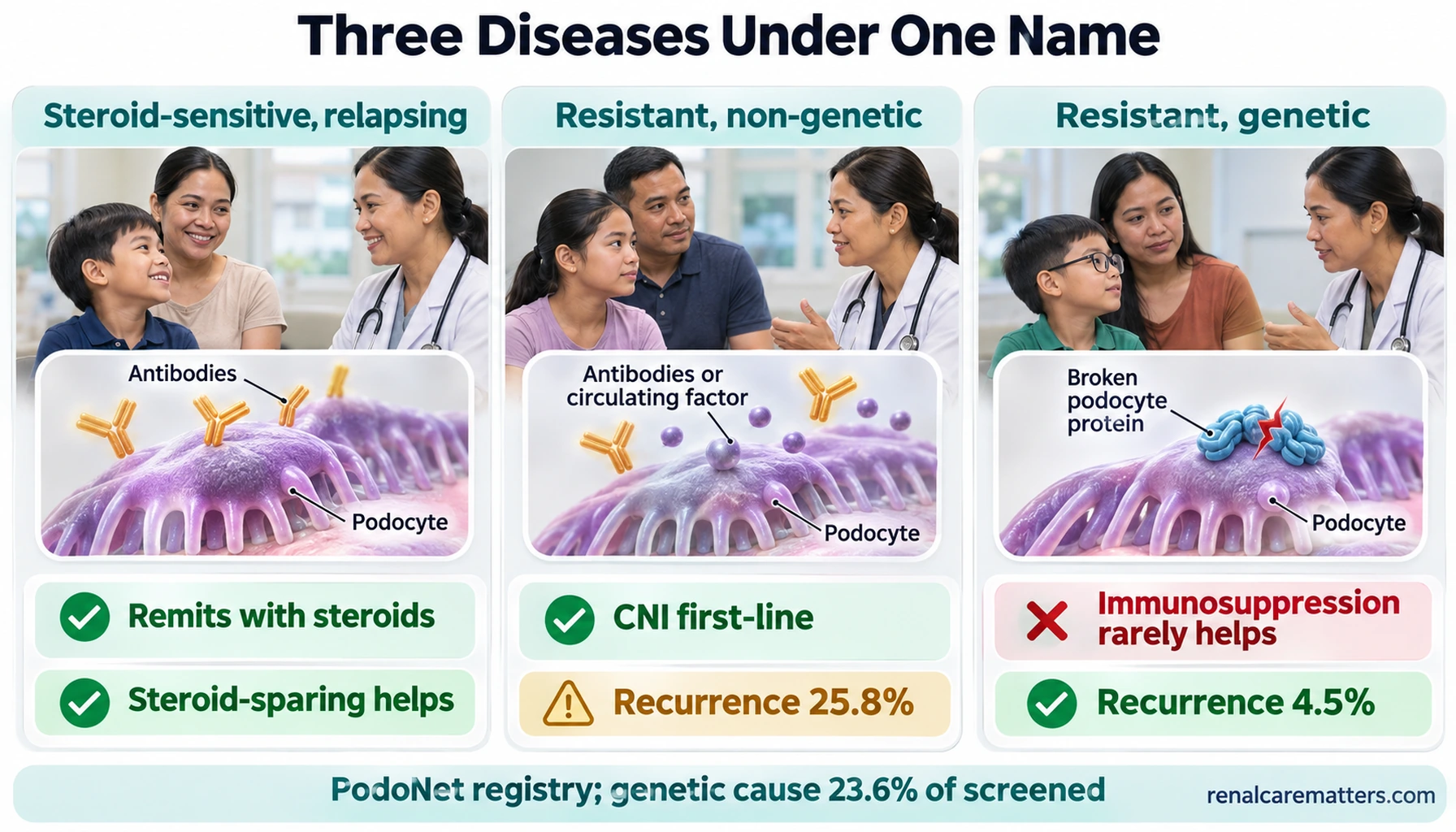
The picture has a limit. In steroid-sensitive disease the “fire” is an immune attack on the podocyte, increasingly linked to antinephrin antibodies and B cells, so steroid-sparing drugs that quiet T cells or remove B cells do address its source. In some steroid-resistant children there is no fire at all: a gene for a podocyte structural protein is broken, and no extinguisher will help. Those children need the immunosuppression stopped, not escalated. Telling the two apart is the core of this module.
Figure 1 · Key numbers
Levamisole RCT (Gruppen 2018)Hazard ratio for relapse 0.22; 26% vs 6% still in remission at 12 months
Rituximab RCT (Iijima 2014)Median relapse-free period 267 vs 101 days (hazard ratio 0.27)
Monogenic cause in SRNS (IPNA 2020)10–30% of children
Tacrolimus vs intravenous (IV) cyclophosphamide in SRNS (Gulati 2012)Complete remission 52.4% vs 14.8%
Recurrence after transplant (PodoNet)25.8% without vs 4.5% with a genetic diagnosis
Most children with frequent relapses or steroid dependence can be kept in remission with less steroid, and many outgrow the disease. A few are steroid resistant, and among them a genetic minority will not respond to any immunosuppression. Your work is to classify the course from dated events, choose a steroid-sparing agent with the family, and investigate resistance quickly enough that the child is neither overtreated nor undertreated.
Opening case · fictional
Case: The fifth relapse
Kristine Joy Manalo is 10 years old. She was diagnosed with nephrotic syndrome at age 4 in Lipa City, Batangas, and responded fully to her first course. Since then she has relapsed again and again. In the past 12 months she has had five relapses. The last two began while her prednisone was being tapered and nine days after it was stopped. Each time a different doctor restarted a full course.
She weighs 41 kg, and her height has crossed down from the 50th to below the 15th percentile in two years. Her blood pressure is 124/82, her face is round, she has striae on her thighs, and last month an ophthalmologist found posterior subcapsular cataracts and prescribed glasses. She has stopped going to school because classmates tease her about her face. Her urine dipstick today is 4+; serum albumin 2.0 g/dL, creatinine 0.5 mg/dL, C3 normal.
The referring pediatrician’s note reads: “Steroid-resistant NS? For biopsy and cyclophosphamide.” Her father drives a tricycle; her mother has read about rituximab in a parents’ Facebook group and asks whether it will “finish” the disease. Her grandmother wants to try herbal tea first.
Before reading on, decide:
How do you classify her course, and does she need a biopsy?
Which steroid-sparing option do you offer, and how do you decide with the family?
If a child does not remit by 6 weeks of glucocorticoids, what changes, and why does a genetic result matter for treatment and transplant?
Keep your answers in mind. The lesson gives you what you need, and the case review near the end shows one sound response.
Lesson · part 1
Why relapses recur, why steroids harm, and why some children never respond
Relapse. In steroid-sensitive disease the podocyte is attacked, not broken. Circulating antinephrin antibodies, produced by B cells with T-cell help, are found in most children with active, untreated disease and fall with remission, as Module 9 described. Infections stimulate the immune system and often precede relapses. Glucocorticoids suppress the attack and also act directly on the podocyte cytoskeleton, so remission comes quickly. When the drug is withdrawn, the immune drive may return.
The cost of steroids in a growing child. Glucocorticoids blunt growth hormone action and growth plate activity, so height velocity falls. They reduce bone formation, raise blood pressure, increase appetite and fat deposition, cause cataracts and glaucoma, disturb sleep, mood and behavior, and raise blood glucose. Each restarted full course adds to a cumulative exposure. The IPNA 2022 recommendations define steroid toxicity as new or worsening obesity or overweight, sustained hypertension, hyperglycemia, behavioral or psychiatric disorders, sleep disruption, impaired growth (height velocity below the 25th percentile or height below the 3rd percentile in a child who grew normally before) and Cushingoid features, among others.1
Resistance. Children whose disease does not remit with glucocorticoids fall into two broad groups. In one, the immune attack is stronger or different, and other immunosuppressants may still work. In the other, a variant in a gene such as NPHS2 (podocin), WT1 or NPHS1 (nephrin) disrupts the podocyte’s structure. Immunosuppression cannot repair a missing protein. The international PodoNet registry, with 1,655 children with steroid-resistant or congenital nephrotic syndrome from 67 centers, found a genetic cause in 23.6% of the 1,174 children screened, falling from 66% in congenital nephrotic syndrome to 15% to 16% in school-age children and adolescents.2
Group
Mechanism
Response to immunosuppression
Recurrence after transplant
Steroid-sensitive, relapsing
Immune podocytopathy (antinephrin antibodies, B and T cells)
Remits with glucocorticoids; steroid-sparing agents reduce relapses
Rarely reaches kidney failure
Steroid-resistant, non-genetic
Immune or circulating-factor disease
Calcineurin inhibitors and rituximab achieved complete remission in 40–45% in PodoNet
High: 25.8% in PodoNet; can begin within hours to days of grafting
These PodoNet figures come from a registry, so they describe what happened to treated children rather than what each drug causes, and genes common in Europe may be less common in Southeast Asian children.2
RememberA steroid-resistant child may have an immune disease you can treat or a structural one you cannot. Find out before you escalate.
Figure 2. Three diseases under one name. Immune disease responds to immunosuppression and can recur in a graft; structural genetic disease rarely responds and rarely recurs (PodoNet: 25.8% vs 4.5%).
Lesson · part 2
Steroid-sparing therapy: what the evidence shows
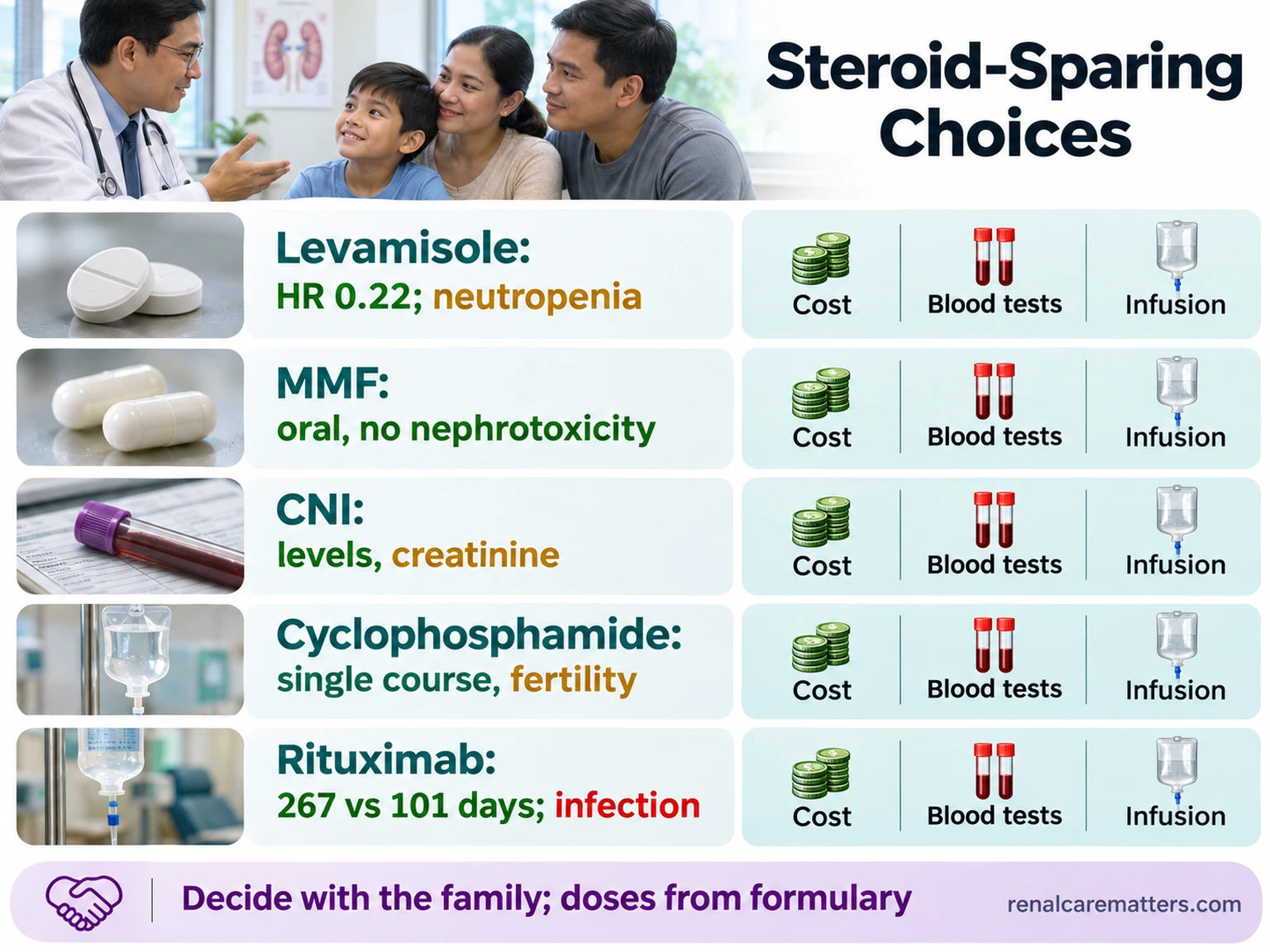
Kidney Disease: Improving Global Outcomes (KDIGO) 2025 recommends glucocorticoid-sparing agents to prevent relapses, rather than no treatment or glucocorticoids alone, for children with frequently relapsing disease who develop serious glucocorticoid-related adverse effects and for all children with steroid-dependent disease (Recommendation 1.3.3.1, graded 1B).3 The 2025 update removed the earlier split between first-line and alternative agents; it notes that rituximab trials used one to four doses without enough data for a specific recommendation, and that mycophenolate after rituximab may reduce treatment failure in complicated cases.4 An ungraded practice point lists oral calcineurin inhibitors, cyclophosphamide, levamisole, mycophenolate mofetil (MMF) and rituximab in an unbiased order and says the choice requires careful consideration of resources, adherence, adverse effects and patient preferences; it adds that oral cyclophosphamide and levamisole may be preferable in frequently relapsing disease, and MMF, rituximab, calcineurin inhibitors and, to a lesser extent, oral cyclophosphamide in steroid-dependent disease.3 The choice is therefore a shared decision, not a ladder.
Levamisole. An international placebo-controlled trial randomized 99 children with steroid-sensitive disease and frequent relapses to levamisole or placebo for one year. Time to relapse was longer with levamisole (hazard ratio 0.22, 95% confidence interval (CI) 0.11 to 0.43). After 12 months, 26% of children on levamisole and 6% on placebo were still in remission. Asymptomatic moderate neutropenia was the most frequent serious adverse event possibly related to the drug, in 4 of 50 children, and it reversed.5 Most children still relapsed within the year, so levamisole lengthens remissions rather than ending the disease, and regular blood counts are required.
Rituximab. A double-blind trial at nine Japanese centers randomized 48 treated children with complicated frequently relapsing or steroid-dependent disease to rituximab or placebo. The median relapse-free period was 267 days with rituximab and 101 days with placebo (hazard ratio 0.27, 95% CI 0.14 to 0.53). Serious adverse events occurred in 42% and 25% (not significantly different).6 Follow-up was one year; most children relapse as B cells return, and hypogammaglobulinemia, infusion reactions and infections need monitoring. Live vaccines are avoided in the first 6 months after rituximab.1
Agent
Evidence anchor
Main harms to discuss
Practical points
Levamisole
RCT, 99 children: heart rate (HR) 0.22; 26% vs 6% in remission at 12 months
Neutropenia; rarely vasculitis
Inexpensive where available; needs blood counts; availability varies
Mycophenolate mofetil
Included in KDIGO 2025 options; may be used after rituximab
Cost; infusion setting; vaccines first; relapse as B cells return
None of these drugs has been shown in children to change kidney survival, because steroid-sensitive disease rarely causes kidney failure. The outcomes that matter are fewer relapses, less steroid exposure, growth, school and quality of life. Head-to-head pediatric trials remain few, so the family’s priorities legitimately drive the choice.
RememberChoose the steroid-sparing agent with the family. The evidence supports several; their harms, costs and routines differ, and the child must live with them.
Figure 3. Choosing a steroid-sparing agent with the family. Levamisole, mycophenolate, calcineurin inhibitors, cyclophosphamide and rituximab differ in evidence, harms, cost and routine.
Lesson · part 3
Steroid resistance: biopsy, genes and calcineurin inhibitors
A child with no complete remission after 4 weeks of standard glucocorticoids enters the confirmation period, from week 4 to week 6. The IPNA 2020 recommendations for steroid-resistant nephrotic syndrome (SRNS) use those two weeks to assess response to further glucocorticoids and to start renin-angiotensin-aldosterone system (RAAS) blockade (grade C, weak recommendation), and recommend genetic testing and/or kidney biopsy during the same window (grade B, moderate recommendation).7 They recommend a comprehensive gene panel covering the known SRNS genes. With exome sequencing, 10% to 30% of children are now diagnosed with a monogenic disease, and the likelihood falls with older age at onset and rises with a family history or extrarenal features.7
Treatment. The IPNA recommends a calcineurin inhibitor, cyclosporine or tacrolimus, as first-line immunosuppression once SRNS is confirmed (grade B, moderate recommendation), withholding or delaying it when estimated glomerular filtration rate (eGFR) is below 30 mL/min/1.73 m², in acute kidney injury (AKI) or with uncontrolled hypertension (grade X, strong recommendation), and withholding it and stopping glucocorticoids when a monogenic form is identified (grade B, moderate recommendation).7 KDIGO 2025 likewise recommends cyclosporine or tacrolimus as initial second-line therapy for SRNS (Recommendation 1.4.1.1, graded 1C).3 Where genetics or histology are not available, the IPNA allows a calcineurin inhibitor to be started; where calcineurin inhibitors are not available, cyclophosphamide may be used.7
The strongest pediatric comparison is a multicenter Indian trial of 131 children with SRNS randomized to tacrolimus for 12 months or six monthly infusions of intravenous cyclophosphamide, both with alternate-day prednisolone. Complete or partial remission at 6 months favored tacrolimus (hazard ratio 2.64), complete remission was 52.4% versus 14.8%, and three children needed tacrolimus for one additional remission. Withdrawals for systemic infection were more common with cyclophosphamide.8 The endpoint was proteinuria remission, a strong surrogate in this disease, not kidney survival.
For antiproteinuric effect, if volume and kidney function allow
IPNA 2020, grade C, weak
Start a calcineurin inhibitor
Unless eGFR <30, AKI, uncontrolled hypertension, or a monogenic cause
IPNA 2020, grade B; KDIGO 2025, 1C
Monogenic result
Stop immunosuppression; supportive care; plan kidney replacement therapy (KRT) and transplant
IPNA 2020, grade B, moderate
In your clinic, week six · fictional
Paolo, 3, from Iloilo, is still 4+ on dipstick after 6 weeks of prednisolone. His parents are first cousins. A biopsy shows focal segmental glomerulosclerosis, and the gene panel, sent abroad, returns two pathogenic NPHS2 variants.
You stop the prednisolone, do not start tacrolimus, continue RAAS blockade and supportive care, and begin the conversation about dialysis and transplantation, including that his disease is unlikely to recur in a graft.
What this shows. A genetic answer spares a child months of toxic drugs that would not have worked.
Transplant planning. Recurrence after transplant is the most feared event in non-genetic SRNS: in PodoNet it occurred in 25.8% of children without a genetic diagnosis and 4.5% with one.2 The IPNA recommends discussing the anticipated recurrence risk with the family when planning kidney replacement therapy (grade A, strong recommendation), and measuring urine protein before transplantation so that recurrence can be recognized afterward (grade A, strong recommendation).7 Module 26 continues this conversation.
RememberAt week 6 without remission, biopsy and gene-test together, start a calcineurin inhibitor for non-genetic disease, and stop immunosuppression for genetic disease.
Lesson · part 4
Deciding with the family, and living with the disease
Name the course first. Lay out the dates: first remission, each relapse, what she was taking and when it stopped. Kristine’s last two relapses came during the taper and nine days after stopping, which is steroid dependence by the IPNA 2022 definition, and she has had five relapses in 12 months, which also meets the definition of frequent relapses.1 She has always remitted, so she is not steroid resistant. The Academy’s nephrotic course classifier, linked below, applies these definitions to the dates you enter.
Count the toxicity. Before the family meeting, list what the steroids have done: growth, weight, blood pressure, eyes, bones, mood, school. Show the family the growth chart. A cataract and a falling height centile are reasons to act now, not after the next relapse.
Decide together. Present two or three options that are available and affordable in your setting, with the numbers above, the routine each requires (daily tablets, blood tests, infusions) and the harms. Ask what matters most to the child and family: school, appearance, fertility, cost, fewer clinic visits. A 10-year-old can give assent and should hear her options in words she understands.
What to monitor
Why
How often
Height, weight, body mass index (BMI) on a growth chart
Steroid growth suppression and obesity
Every visit
Blood pressure, measured correctly
Steroid and CNI hypertension
Every visit
Eye examination
Cataract, glaucoma
At intervals while on steroids, per your ophthalmologist
Blood counts, creatinine, drug levels
Drug-specific toxicity
As the protocol for the chosen agent sets
Mood, sleep, school attendance
Behavioral toxicity and stigma
Every visit; involve the school when needed
Philippine realities. Cost and supply decide more choices than trials do. Check with the hospital pharmacy what is stocked before you offer it, ask the social service office early about financial assistance, and avoid starting a drug the family cannot continue. Herbal products are a frequent request; ask about them without judgment, explain that none has been shown to prevent relapses, and warn that some may harm the kidney or interact with immunosuppressants.
Figure 4 · Relapsing child, clinic visit
List the datesRemission, relapses, therapy at each relapse; classify with the IPNA definitions.
Count the toxicityGrowth chart, blood pressure, eyes, bones, mood, school.
Rule out resistanceHas she ever had complete remission within 4–6 weeks? If yes, she is not SRNS; no biopsy for typical disease.
Choose a steroid-sparing agentShared decision on levamisole, MMF, CNI, cyclophosphamide or rituximab; check stock and cost; consent and assent.
PrepareVaccines before immunosuppression where possible; baseline blood tests the protocol requires.
FollowRelapse diary, toxicity checks, and a review date to decide whether the agent is working.
Stop and call
No complete remission after 4 weeks of standard glucocorticoids (enter the confirmation period; plan biopsy and genetics)
A rising creatinine on a calcineurin inhibitor
Fever or severe infection after rituximab or on combined immunosuppression
New visual symptoms, hypertensive urgency or severe mood change on steroids
RememberEvery restarted full course of glucocorticoids is a decision. If the child has toxicity, the next decision is a steroid-sparing plan.
On the floor
Real situations: problems and solutions
These are fictional but typical. For each one, cover the answer, decide what you would do, then compare. Where a step depends on local rules, your unit’s procedure and your supervisor’s direction come first.
The referral that says “steroid resistant”
What you see
A referral for biopsy describes a child who has relapsed six times but has remitted within two weeks every time.
What is likely going on
The child is steroid dependent or frequently relapsing, not resistant; the label is wrong.
What to do
Rebuild the timeline, classify with the IPNA definitions, correct the note, and plan a steroid-sparing agent instead of a biopsy.
Why it matters
A wrong label leads to an unnecessary biopsy and to drugs chosen for the wrong disease.
The rising creatinine on tacrolimus
What you see
A 9-year-old on tacrolimus for SRNS in remission has a creatinine that has risen 30% over three months with a trough at the top of range.
What is likely going on
Calcineurin inhibitor nephrotoxicity is likely; dehydration and drug interactions are possible contributors.
What to do
Review interacting drugs and intake, recheck the level, adjust with the protocol, and consider biopsy or a switch if function does not recover.
Why it matters
CNIs control proteinuria at a kidney cost that must be watched, not assumed.
Fever two months after rituximab
What you see
A child who received rituximab eight weeks ago presents with fever, cough and low oxygen saturation.
What is likely going on
Serious infection on B-cell depletion, sometimes with low immunoglobulin.
What to do
Admit, culture, treat promptly, check immunoglobulin levels, and inform the treating nephrologist.
Why it matters
In the Japanese trial, serious adverse events occurred in 42% of children given rituximab and 25% given placebo (not significant); infection is the main concern in practice.
The gene result after six months of drugs
What you see
A child with SRNS has been on tacrolimus for six months without remission when the gene panel returns two pathogenic podocin variants.
What is likely going on
Monogenic SRNS, which rarely responds to immunosuppression.
What to do
Stop the immunosuppression, continue supportive care, and start planning for dialysis and transplant with a low expected recurrence risk.
Why it matters
The IPNA recommends withholding CNIs and stopping glucocorticoids in monogenic disease (grade B).
Field notes
Keep a one-line relapse timeline at the top of every nephrotic chart.
Photograph the growth chart and show it to the family at the decision meeting.
Check pharmacy stock and cost before offering a steroid-sparing drug.
Send the gene panel and the biopsy request in the same week as the diagnosis of SRNS.
Case review
Back to the case: The fifth relapse
Classification and biopsy. Kristine is steroid dependent (two consecutive relapses during the taper and within 14 days of stopping) and frequently relapsing (five relapses in 12 months) by the IPNA 2022 definitions. She has always remitted, so she is not steroid resistant, and with typical disease and a normal C3 she does not need a biopsy. Correct the referral note, because the label “steroid resistant” would send her down the wrong path.
Choosing a steroid-sparing agent. Her cataract, slowed growth, hypertension and school refusal are glucocorticoid complications, and as a steroid-dependent child she falls within KDIGO 2025’s recommendation for a steroid-sparing agent (1B), for which the guideline suggests MMF, rituximab or a calcineurin inhibitor may be preferable. Treat the current relapse as the guideline describes with the dose from the unit formulary, then offer the options that are available and affordable: for example MMF as an oral option, a calcineurin inhibitor with levels and creatinine monitoring, or rituximab if the family can access it, with the Japanese trial’s 267 versus 101 relapse-free days explained honestly as a longer remission, not a cure. At her age, discuss fertility before any cyclophosphamide. Ask Kristine what matters most to her, involve social service early, and talk about the herbal tea without judgment.
When a child does not remit. No complete remission at 4 weeks starts the confirmation period; none by 6 weeks is SRNS. Then biopsy and a comprehensive gene panel go together (IPNA 2020, grade B), RAAS blockade starts if safe, and a calcineurin inhibitor is first-line for non-genetic disease (IPNA grade B; KDIGO 2025, 1C). A monogenic result means stopping immunosuppression, because it rarely works and only adds harm, and it changes the transplant conversation: in PodoNet, recurrence after transplant was 4.5% with a genetic diagnosis and 25.8% without.
Skills lab · with your preceptor
Skills checklist: Frequent relapses, steroid dependence and steroid resistance
Complete with a preceptor, in simulation or at your own unit. Sign-off is local. Your preceptor rates each step as satisfactory, needs practice, or not observed. Steps marked Critical must all be satisfactory before sign-off. This checklist supports supervised learning; your unit’s own procedure and competency form are the authority. A printable version of every checklist is on the trainer page.
Builds a dated relapse timeline and classifies the course with the IPNA definitions
Documents steroid toxicity using growth chart, blood pressure and eye findings
Leads a shared decision on a steroid-sparing agent, including cost, availability and assent
Plans biopsy, gene testing and calcineurin inhibitor therapy for confirmed SRNS
Placement activity. Pediatric nephrology clinic
Self-assessment
Check your understanding
Each visit draws 5 questions at random from this module’s 5-question bank. Choose the single best answer for each, then select Check answers; an explanation appears under the best answer. Select New set of questions for a different mix. A good target is 4 of 5 on two different sets. Nothing you select is sent anywhere; scoring happens in your browser.
Trautmann, A., Boyer, O., Hodson, E., Bagga, A., Gipson, D. S., Samuel, S., Wetzels, J., Alhasan, K., Banerjee, S., Bhimma, R., Bonilla-Felix, M., Cano, F., Christian, M., Hahn, D., Kang, H. G., Nakanishi, K., Safouh, H., Trachtman, H., Xu, H., . . . International Pediatric Nephrology Association. (2023). IPNA clinical practice recommendations for the diagnosis and management of children with steroid-sensitive nephrotic syndrome. Pediatric Nephrology, 38(3), 877–919. https://doi.org/10.1007/s00467-022-05739-3
Trautmann, A., Bodria, M., Ozaltin, F., Gheisari, A., Melk, A., Azocar, M., Anarat, A., Caliskan, S., Emma, F., Gellermann, J., Oh, J., Baskin, E., Ksiazek, J., Remuzzi, G., Erdogan, O., Akman, S., Dusek, J., Davitaia, T., Özkaya, O., . . . PodoNet Consortium. (2015). Spectrum of steroid-resistant and congenital nephrotic syndrome in children: The PodoNet registry cohort. Clinical Journal of the American Society of Nephrology, 10(4), 592–600. https://doi.org/10.2215/CJN.06260614
Kidney Disease: Improving Global Outcomes (KDIGO) Nephrotic Syndrome in Children Work Group. (2025). KDIGO 2025 clinical practice guideline for the management of nephrotic syndrome in children. Kidney International, 107(5S), S241–S289. https://doi.org/10.1016/j.kint.2024.11.007
Floege, J., Gibson, K. L., Vivarelli, M., Liew, A., Radhakrishnan, J., Balk, E. M., Gordon, C. E., Adam, G., Tonelli, M., Earley, A., & Rovin, B. H. (2025). Executive summary of the KDIGO 2025 clinical practice guideline for the management of nephrotic syndrome in children. Kidney International, 107(5), 806–808. https://doi.org/10.1016/j.kint.2024.11.006
Gruppen, M. P., Bouts, A. H., Jansen-van der Weide, M. C., Merkus, M. P., Zurowska, A., Maternik, M., Massella, L., Emma, F., Niaudet, P., Cornelissen, E. A. M., Schurmans, T., Raes, A., van de Walle, J., van Dyck, M., Gulati, A., Bagga, A., Davin, J. C., & all members of the Levamisole Study Group. (2018). A randomized clinical trial indicates that levamisole increases the time to relapse in children with steroid-sensitive idiopathic nephrotic syndrome. Kidney International, 93(2), 510–518. https://doi.org/10.1016/j.kint.2017.08.011
Iijima, K., Sako, M., Nozu, K., Mori, R., Tuchida, N., Kamei, K., Miura, K., Aya, K., Nakanishi, K., Ohtomo, Y., Takahashi, S., Tanaka, R., Kaito, H., Nakamura, H., Ishikura, K., Ito, S., Ohashi, Y., & Rituximab for Childhood-onset Refractory Nephrotic Syndrome (RCRNS) Study Group. (2014). Rituximab for childhood-onset, complicated, frequently relapsing nephrotic syndrome or steroid-dependent nephrotic syndrome: A multicentre, double-blind, randomised, placebo-controlled trial. Lancet, 384(9950), 1273–1281. https://doi.org/10.1016/S0140-6736(14)60541-9
Trautmann, A., Vivarelli, M., Samuel, S., Gipson, D., Sinha, A., Schaefer, F., Hui, N. K., Boyer, O., Saleem, M. A., Feltran, L., Müller-Deile, J., Becker, J. U., Cano, F., Xu, H., Lim, Y. N., Smoyer, W., Anochie, I., Nakanishi, K., Hodson, E., . . . International Pediatric Nephrology Association. (2020). IPNA clinical practice recommendations for the diagnosis and management of children with steroid-resistant nephrotic syndrome. Pediatric Nephrology, 35(8), 1529–1561. https://doi.org/10.1007/s00467-020-04519-1
Gulati, A., Sinha, A., Gupta, A., Kanitkar, M., Sreenivas, V., Sharma, J., Mantan, M., Agarwal, I., Dinda, A. K., Hari, P., & Bagga, A. (2012). Treatment with tacrolimus and prednisolone is preferable to intravenous cyclophosphamide as the initial therapy for children with steroid-resistant nephrotic syndrome. Kidney International, 82(10), 1130–1135. https://doi.org/10.1038/ki.2012.238
Educational material for physicians. Completing it is an Academy learning record only. It does not confer CPD units, PNSP or board certification, privileges, or PhilHealth accreditation, and it does not replace current guidelines, regulations, your institution’s pediatric protocols and formulary, or clinical judgment.