Urinary tract infection, reflux and bladder-bowel dysfunction
Diagnose febrile UTI correctly, decide on imaging and prophylaxis from RIVUR and PREDICT, and treat the bladder and bowel.
PublishedNailathalaGipatikPepalwal:ReferencesMga SanggunianMga TinubdanReng Reperensya:8Audience: Pediatric nephrologists · pediatric nephrology fellows · adult nephrologists, intensivists and neonatologists who share kidney care for children in the clinic, ward, NICU, PICU, dialysis unit and homeRead timeOras ng pagbasaOras sa pagbasaOras ning pamamasa:
Training track for attending pediatric nephrologists
This module is study material for attending pediatric nephrologists and fellows. It explains the reasoning behind common decisions; it is not a protocol and it gives no doses. Doses, fill volumes and thresholds must come from current pediatric guidelines, product labels, your institution’s approved pediatric protocols and a pediatric pharmacist. Benefit rules change: confirm them on the date of service. Every case is fictional.
Learning objectives
After this module you should be able to
Diagnose febrile urinary tract infection (UTI) in an infant from a properly collected specimen, and choose imaging the way the American Academy of Pediatrics (AAP) guideline describes.
Weigh antibiotic prophylaxis for vesicoureteral reflux (VUR) with a family, using the absolute numbers from RIVUR and PREDICT and what those trials do not show.
Recognize and treat bladder and bowel dysfunction (BBD) as a driver of recurrent UTI in the toilet-trained child.
Pre-testBefore you read, answer the 5 self-assessment questions and note your score. After the module, select New set of questions and compare. The difference is what you learned; the questions you still miss are what to reread.
Start here
The big picture, in plain words
Your role · the kidney behind the feverThe pediatrician on the ward treats the infection. You are asked about the kidneys: was it really a UTI, does this child need imaging, prophylaxis or a urologist, and who checks the kidneys next year. Your answer often arrives by Viber to a provincial hospital, and it shapes years of antibiotics, radiation and worry for a family.
In plain wordsThink of the urinary tract as a one-way street with a strong current. Urine flows down from the kidneys and out of the bladder several times a day, and the flow sweeps bacteria out before they can settle. Infection needs a stalled current or a road that runs the wrong way.
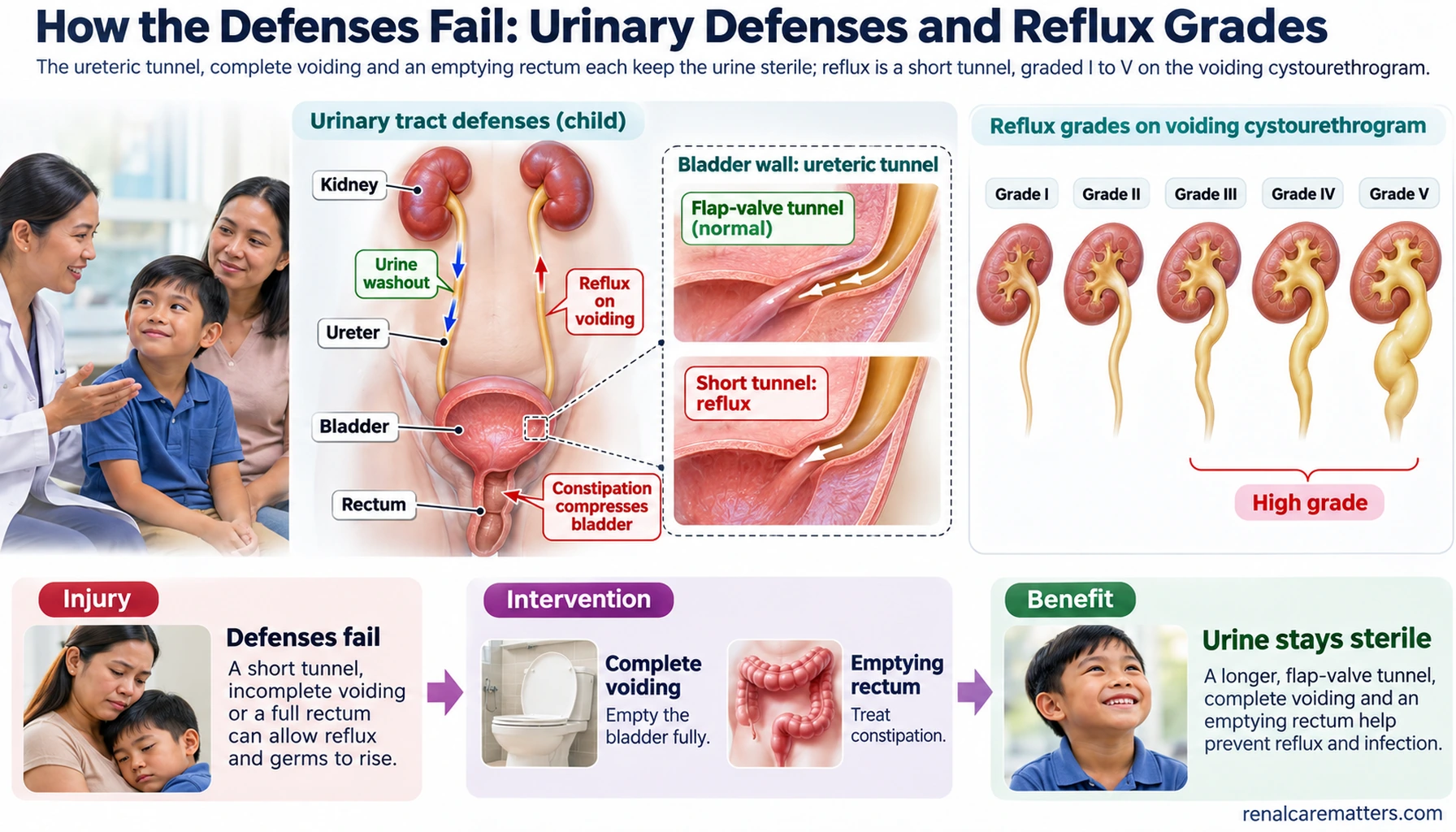
The picture has a limit. The current is only one defense. The bladder lining sheds bacteria, urine itself is hostile to many organisms, and the ureter enters the bladder through a tunnel in the wall that closes like a flap valve when the bladder squeezes. Reflux is a short tunnel that leaks. Stasis is a bladder that never empties or a rectum full of stool pressing on it. Fever means the bacteria have reached the kidney, and the kidney’s own inflammatory response, not the bacteria alone, can leave a scar.
Figure 1 · Key numbers
AAP 2011 diagnosisPyuria and at least 50,000 colonies per mL of a single uropathogen in an appropriately collected specimen
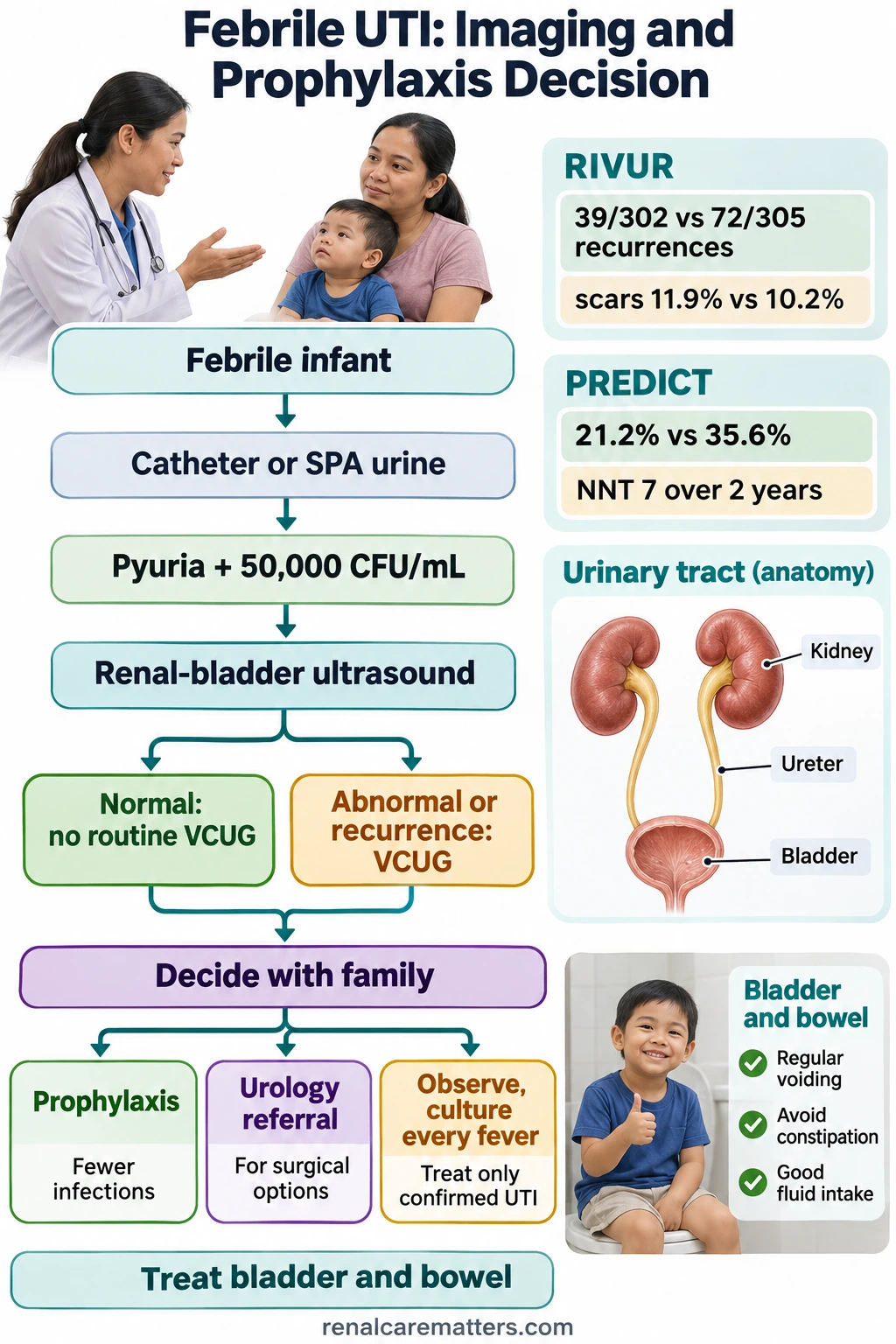
RIVUR, recurrent UTI over 2 years39 of 302 on prophylaxis vs 72 of 305 on placebo
RIVUR, renal scarring11.9% vs 10.2% (no significant difference)
RIVUR, resistant E. coli at first recurrence63% vs 19% resistant to trimethoprim-sulfamethoxazole
PREDICT, first UTI in infants with grade III–V reflux21.2% vs 35.6%; number needed to treat 7 over 2 years
Bladder and bowel dysfunction plus any reflux56% had a recurrent febrile or symptomatic UTI over 2 years
Most febrile UTIs in infants are single events in kidneys that heal. A few mark a child with high-grade reflux, an obstructed or dysplastic kidney, or a bladder that does not empty, whose kidneys will scar with each new infection. Your work is to confirm the diagnosis honestly, image the children who need it, choose prophylaxis or surgery with the family from real numbers, and treat the bladder and bowel that the urine culture never shows.
Opening case · fictional
Case: The second fever
It is 9 p.m. on a Tuesday. Gabriel Dizon, 7 months old and 7.8 kg, is on the pediatric ward of a provincial hospital in Tarlac City with a temperature of 39.4°C, poor feeding and irritability. A catheter urine sample shows many white cells and is nitrite positive. Blood and urine cultures are pending, and the resident has started intravenous antibiotics from the ward’s formulary. Creatinine is 0.3 mg/dL.
At 4 months he had a fever, a bag urine culture grew E. coli, and he was treated with oral antibiotics at home. A renal and bladder ultrasound afterward showed a dilated left collecting system. A voiding cystourethrogram (VCUG) at 5 months showed grade intravenous (IV) reflux on the left. No one started prophylaxis, and no one booked a follow-up.
The resident sends you a photo of the VCUG report on Viber with the note: “For reimplantation? Parents want surgery now.” Gabriel’s father, a seafarer, calls in from abroad on video. His sister-in-law is a nurse who has read that surgery cures reflux. “Doc, we do not want him on antibiotics for years. Just fix it.”
Before reading on, decide:
Was the first episode really a UTI, and what makes this one certain?
Prophylaxis, surgery or watchful waiting: what do you offer for an infant with grade IV reflux and two febrile UTIs?
What do you tell the family about scarring, and what will actually protect his kidneys?
Keep your answers in mind. The lesson gives you what you need, and the case review near the end shows one sound response.
Lesson · part 1
How the defenses fail
Most UTIs start in the bowel. Fecal E. coli colonize the perineum and climb the urethra. In the bladder, bacteria with adhesive fimbriae attach to the lining. Frequent, complete voiding washes most of them out before they multiply.
The ureter runs obliquely through the bladder wall before it opens. As the bladder fills and contracts, the wall compresses that tunnel and seals it. A tunnel that is too short, or a ureteric opening placed too far laterally, lets urine run back up the ureter during voiding. That is primary vesicoureteral reflux (VUR). The tunnel often lengthens as the child grows, which is why low grades of reflux tend to resolve.
Reflux alone does not injure the kidney. Infected reflux does. Bacteria carried into the renal pelvis reach the papillae, and compound papillae at the poles of the kidney let urine into the collecting ducts more easily. Neutrophils and cytokines that clear the infection also damage tubules and interstitium. Where inflammation is intense, fibrosis follows, and the scar is visible later on a dimercaptosuccinic acid (DMSA) scan as a cold area.
Not every scar comes from infection. Some boys with high-grade reflux are born with small, dysplastic kidneys, and the defect was present before any UTI. That distinction matters when a family asks whether the antibiotics they missed caused the damage.
Defense
What weakens it
What you may see
Washout by voiding
Infrequent voiding, holding, incomplete emptying, a neurogenic bladder
Large post-void residual, daytime wetting, holding maneuvers
Flap-valve ureter
Short submucosal tunnel (primary reflux); high bladder pressure (secondary reflux, as with valves)
Dilated ureter and pelvis on ultrasound; reflux on VCUG
Free outflow
Posterior urethral valves, ureteropelvic or ureterovesical junction obstruction
Hydronephrosis, thick-walled bladder, poor stream in a boy
A rectum that empties
Constipation, which compresses the bladder and holds a fecal reservoir near the urethra
Hard stools, soiling, a palpable fecal mass, recurrent cystitis in a girl
A kidney that limits inflammation
Young age, delay in treatment, high-grade reflux, prior scars
New DMSA defects after febrile UTI
Bladder and bowel dysfunction (BBD) is the name for the last two rows together in a toilet-trained child. The child postpones voiding, squats on a heel or crosses the legs to hold, empties partly, and is often constipated. The bladder works against a closed sphincter at high pressure, and residual urine incubates bacteria. In this setting reflux can be secondary, and it may improve when the voiding pattern improves.
RememberAsk which defense failed. A short tunnel, an obstructed outlet and a bladder that never empties each call for different treatment.
Figure 2. How the defenses fail. The ureteric tunnel, complete voiding and an emptying rectum each keep the urine sterile; reflux is a short tunnel, graded I to V on the voiding cystourethrogram.
Lesson · part 2
Getting the diagnosis and the imaging right
A UTI diagnosis commits an infant to imaging, possible prophylaxis and years of follow-up. It has to be real. The AAP 2011 guideline for febrile infants and children aged 2 to 24 months requires both pyuria and at least 50,000 colonies per mL of a single uropathogen in an appropriately collected specimen.1 The AAP reaffirmed the guideline in 2016.2
Specimen
When it is used
How far to trust a positive culture
Urethral catheter
Standard for the febrile infant who is not toilet trained
High, when collected cleanly
Suprapubic aspiration (SPA)
Infant with a full bladder, often ultrasound guided
Highest; any growth is significant
Clean-catch midstream
Toilet-trained child
Reasonable, if collected with cleaning and supervision
Bag
Convenient, so it is common on busy wards
Low. Skin and stool contaminate it. A negative bag urinalysis helps; a positive bag culture does not establish UTI
Gabriel’s first episode was diagnosed from a bag culture. It may well have been a UTI, given the later reflux, but no one can say. The second episode, from a catheter specimen with pyuria and a positive nitrite in a febrile infant, is the one to count, once the culture confirms a single uropathogen.
On a Viber thread from a district hospital · fictional
A resident messages you about a 10-month-old girl with fever and a bag urine culture growing three organisms. She asks whether to book a VCUG.
You ask for a catheter specimen before the next dose of antibiotic, if the child is not yet treated, and you point out that three organisms in a bag specimen are almost always skin and stool.
What this shows. A contaminated specimen can start a cascade of radiation and prophylaxis for a child who never had a UTI.
Imaging. The AAP advises renal and bladder ultrasound after a first febrile UTI to look for anatomic abnormalities. It does not advise a routine VCUG after a first febrile UTI. A VCUG is indicated when the ultrasound shows hydronephrosis, scarring or other findings that suggest high-grade reflux or obstruction, in other atypical or complex circumstances, and after a recurrent febrile UTI.1 Gabriel met two of those criteria: a dilated collecting system and a recurrence.
Grading. The International Reflux Study grades reflux on the VCUG from I to V by how far contrast fills and dilates the ureter, pelvis and calyces, and it set a standardized voiding cystography technique so that grades are comparable between centers.3
Grade
What the VCUG shows
What it usually means
I
Contrast into the ureter only
Low risk; often resolves
II
Ureter, pelvis and calyces filled, no dilatation
Low risk; often resolves
III
Mild to moderate dilatation, minimal blunting of calyces
Intermediate
IV
Moderate dilatation and tortuosity of the ureter, blunted calyces
High grade; scarring and dysplasia more likely
V
Gross dilatation and tortuosity, loss of papillary impressions
High grade; often congenital renal damage
Route and length of treatment. A multicenter randomized trial in 306 febrile children aged 1 to 24 months compared oral cefixime with initial intravenous cefotaxime followed by oral therapy. Urine was sterile within 24 hours in all children, time to defervescence was similar, and renal scarring at 6 months was 9.8% with oral therapy and 7.2% with initial intravenous therapy, a difference the authors did not find significant.4 That trial predates current resistance patterns, so oral treatment works only when the organism is susceptible to the oral drug. On length, the AAP describes 7 to 14 days of treatment.1 The SCOUT noninferiority trial randomized 664 children aged 2 months to 10 years who had improved after 5 days of antibiotics to 5 more days or placebo. Treatment failure was 0.6% with the standard course and 4.2% with the short course, an absolute difference of 3.6%. Most participants were girls (96%), so the result says little about febrile infant boys like Gabriel.5 The drug, the route and the dose come from your unit’s pediatric formulary and the culture result.
RememberCount only properly collected specimens. One honest UTI is worth more than three bag cultures.
Lesson · part 3
Prophylaxis: what RIVUR and PREDICT show
Continuous low-dose antibiotic prophylaxis keeps the bladder urine sterile while the reflux has a chance to resolve. The question is whether that protects kidneys, and at what cost.
RIVUR. The Randomized Intervention for Children with Vesicoureteral Reflux trial enrolled 607 children aged 2 to 71 months with grade I to IV reflux diagnosed after a first or second febrile or symptomatic UTI, and randomized them to trimethoprim-sulfamethoxazole (transmembrane pressure (TMP)-SMX) or placebo for 2 years. Recurrent UTI occurred in 39 of 302 children on prophylaxis and 72 of 305 on placebo (relative risk 0.55; hazard ratio 0.50). The benefit was larger when the index infection was febrile (hazard ratio 0.41) and in children with baseline BBD (hazard ratio 0.21). Renal scarring did not differ: 11.9% with prophylaxis and 10.2% with placebo. Among 87 children whose first recurrence grew E. coli, 63% of isolates were TMP-SMX resistant on prophylaxis and 19% on placebo.6
In absolute terms, about 13 of every 100 children on prophylaxis and about 24 of every 100 on placebo had a recurrence over 2 years. Roughly nine children were treated for 2 years to prevent one recurrence, and the scar rate did not move. RIVUR excluded grade V reflux and enrolled few infants with grade IV, so it cannot answer Gabriel’s question directly.
PREDICT. This open-label trial in 39 European centers randomized 292 infants aged 1 to 5 months with grade III, IV or V reflux and no previous UTI to prophylaxis or no treatment for 24 months; 80.5% had grade IV or V. A first UTI occurred in 21.2% with prophylaxis and 35.6% without (hazard ratio 0.55), and the number needed to treat for 2 years to prevent one UTI was 7. Among untreated infants, 64.4% had no UTI at all. New kidney scars and estimated glomerular filtration rate at 24 months did not differ substantially, and Pseudomonas, other non-E. coli organisms and resistance were more common in the prophylaxis group.7 PREDICT enrolled infants before any UTI, mostly boys, so Gabriel, with two febrile UTIs already, sits at higher risk than its average participant.
Trial
Who
What prophylaxis did
What the trial does not show
RIVUR, 2014
607 children, 2–71 months, grade I–IV, after 1–2 UTIs
Halved recurrences (39/302 vs 72/305)
Any reduction in scarring (11.9% vs 10.2%); any effect in grade V
PREDICT, 2023
292 infants, 1–5 months, grade III–V, no prior UTI
First UTI 21.2% vs 35.6%; number needed to treat (NNT) 7 over 2 years
A difference in new scars or estimated glomerular filtration rate (eGFR) at 24 months; effect after prior UTIs
RIVUR/CUTIE cohort, 2015
305 placebo children with reflux, 195 without
Not a prophylaxis comparison
Causation: it identifies risk factors (BBD, baseline scars) only
Risk factors. A 2-year cohort that combined the RIVUR placebo arm with 195 children without reflux from the Careful Urinary Tract Infection Evaluation (CUTIE) study found that recurrence was more common with reflux (25.4% vs 17.3%), with baseline BBD (adjusted hazard ratio 2.07) and with a baseline scar on DMSA (adjusted hazard ratio 2.88). Children with BBD and any grade of reflux had the highest risk, 56%.8
What neither trial tested. Neither trial compared prophylaxis with surgery, and neither was large or long enough to show an effect on hypertension, chronic kidney disease (CKD) or kidney failure. Scarring on DMSA is a surrogate. The outcomes families care about lie decades away and have not been measured in these trials. Surgical correction, endoscopic or open, is a decision you make with pediatric urology, usually for breakthrough febrile infections on prophylaxis, high-grade reflux with new scarring, or a family that cannot sustain daily antibiotics.
RememberProphylaxis prevents some infections. It has not been shown to prevent scars. Say both halves to every family.
Figure 3. After a febrile UTI. Confirm with a proper specimen, image on purpose, then decide with the family using absolute numbers: prophylaxis reduces infections but has not been shown to reduce scars.
Lesson · part 4
Bladder, bowel and the attending’s plan
Treat the infection with the culture in hand. Febrile infants who look septic, who cannot keep oral medicine down, or who are very young start intravenously, as your unit’s protocol describes. Switch to an oral drug the organism is susceptible to once the child is improving. Know your hospital’s antibiogram. A drug chosen because it is on the stock list and not because the organism is susceptible is a common reason for slow defervescence.
Image on purpose. Renal and bladder ultrasound after a first febrile UTI. VCUG when the ultrasound is abnormal, the course is atypical, or the fever recurs. A DMSA scan, when your center offers one, is most useful several months after the infection to document scars, not during it. Each test exposes the child to sedation, radiation or a catheter, so every order should change a decision.
Decide with the family. Lay out three paths for a child like Gabriel: prophylaxis with an agreed review date, surgical referral, or careful observation with a fast route to a urine culture at every fever. Give the numbers. Explain that prophylaxis cuts infections, that it has not been shown to prevent scars, and that resistant organisms follow. Agree who checks adherence, who sends the culture at the next fever, and who decides when to stop.
Look for BBD in every toilet-trained child. Ask about voiding frequency, urgency, daytime wetting, holding postures and stool form. A child who passes urine twice a day at school and once at home, and stools every four days, is not ready for a reflux operation.
BBD clue
What it reflects
What you do
Voids fewer than four times a day
Postponement; a bladder that is never emptied fully
Timed voiding every 2 to 3 hours, including at school
Squatting, leg crossing, urgency
Overactive detrusor fought by the sphincter
Voiding diary; refer for urotherapy if it persists
Hard or infrequent stools, soiling
Constipation compressing the bladder
Treat constipation first and fully, then reassess the UTIs
Recurrent cystitis in a school-age girl with normal ultrasound
BBD more often than an anatomic problem
Treat BBD before ordering a VCUG
School adds its own pressure. Ask whether the child avoids the school toilet because it lacks water, privacy or soap, and whether she drinks little so that she will not need to go. If she does, and write a note to the school asking that the child be allowed to drink and void freely.
In your clinic, the fourth infection · fictional
Bea, 6, has had four episodes of cystitis this year. Her ultrasound is normal. Her mother asks for a VCUG. You learn that Bea passes urine twice a day, holds until she squats, and has hard stools every few days.
You start a constipation regimen and timed voiding, give a voiding diary and ask the school to let her use the clinic toilet. Over six months she has one infection.
What this shows. In a school-age girl, the bladder and bowel are usually the problem, and they are treated without radiation.
Figure 4 · After a febrile UTI
ConfirmCatheter or SPA specimen in the infant; pyuria plus a single uropathogen at the AAP threshold.
TreatBy the culture and the unit’s pediatric formulary; switch to oral when improving.
UltrasoundRenal and bladder ultrasound after the first febrile UTI.
VCUG if indicatedAbnormal ultrasound, atypical course, or recurrence.
Decide with the familyProphylaxis, surgical referral or observation, with RIVUR and PREDICT numbers and an agreed review date.
Treat the bladder and bowelIn every toilet-trained child with recurrence.
Follow the kidneysBlood pressure, urinalysis and growth at intervals; creatinine when scars or reduced kidney size are present.
Stop and call
Febrile infant who is septic, lethargic or not feeding
No clinical improvement after about 48 hours of appropriate therapy (think obstruction, abscess or a resistant organism)
A rising creatinine, a solitary kidney or bilateral hydronephrosis
A boy with poor stream, a palpable bladder or a thick-walled bladder on ultrasound (think posterior urethral valves, Module 6)
RememberEvery child with scarred kidneys needs a named person who checks blood pressure and urine for years. If no one else owns it, you do.
On the floor
Real situations: problems and solutions
These are fictional but typical. For each one, cover the answer, decide what you would do, then compare. Where a step depends on local rules, your unit’s procedure and your supervisor’s direction come first.
The VCUG requested for a bag culture
What you see
A district hospital resident books a VCUG for a febrile 9-month-old whose only urine test was a bag culture with mixed growth.
What is likely going on
The diagnosis rests on a contaminated specimen, and the child may never have had a UTI.
What to do
Ask for a catheter specimen with urinalysis at the next fever, before antibiotics. Hold the VCUG until a UTI is confirmed or the ultrasound is abnormal.
Why it matters
Every VCUG means a catheter and radiation. It should follow a real diagnosis, not a convenient specimen.
The breakthrough infection on prophylaxis
What you see
A 14-month-old with grade IV reflux on daily prophylaxis has a second febrile UTI; the culture is resistant to the prophylactic drug.
What is likely going on
Prophylaxis is failing, as RIVUR and PREDICT predict for a share of children, and resistance has followed.
What to do
Treat by susceptibilities, confirm adherence without blame, and refer to pediatric urology to discuss correction. Repeat imaging only if it will change the plan.
Why it matters
Breakthrough febrile infection is the most common reason to move from prophylaxis to surgery.
The girl with a normal ultrasound and four infections
What you see
A 7-year-old girl has recurrent cystitis, a normal ultrasound, daytime wetting and hard stools; her mother wants a VCUG and an operation.
What is likely going on
Bladder and bowel dysfunction is driving the infections.
What to do
Start constipation treatment and timed voiding, give a voiding diary, write to the school, and review in three months.
Why it matters
In the RIVUR/CUTIE cohort, BBD doubled the hazard of recurrence; treating it avoids radiation and surgery.
The scarred kidney no one follows
What you see
A 12-year-old seen for a sports clearance has a small right kidney with scars from infant UTIs; no one has checked his blood pressure since age 3.
What is likely going on
Scarred kidneys carry a lifelong risk of hypertension and proteinuria, and follow-up was lost at the handover from the pediatrician.
What to do
Measure blood pressure properly, check urine protein and creatinine, and set a yearly review with a named owner.
Why it matters
DMSA scars are a surrogate; the outcomes that matter, hypertension and CKD, appear years later and only if someone looks.
Field notes
Write “catheter specimen” or “bag specimen” next to every urine culture result in a referral note.
Ask for the hospital antibiogram once a year and keep a copy on your phone.
When you advise prophylaxis, write the review date and the stop criteria in the same note.
Ask every toilet-trained child with UTI how many times a day they void and how often they pass stool.
Case review
Back to the case: The second fever
Was it really a UTI? The first episode is uncertain, because a bag culture cannot establish the diagnosis. The second meets the AAP definition if the catheter culture grows at least 50,000 colonies per mL of a single uropathogen with the pyuria already seen. Count this one, and make sure the culture is followed up and the organism’s susceptibilities guide the oral switch.
Prophylaxis, surgery or observation? Gabriel has grade IV reflux, a dilated system and now two febrile infections. Prophylaxis is reasonable while he is seen by pediatric urology: in PREDICT it lowered first infections in infants with grade III to V reflux (21.2% vs 35.6%, NNT 7 over 2 years), at the price of more resistant and non-E. coli organisms. Surgery is a fair option to discuss with the urologist, especially if he has a breakthrough febrile UTI or a new scar. It is not an emergency tonight, and no trial shows that operating now protects his kidneys better than prophylaxis with close follow-up.
What protects his kidneys? Tell the family the truth in both halves: prophylaxis prevents some infections, but neither RIVUR nor PREDICT showed fewer scars. What protects the kidney is a prompt, properly collected urine culture at every fever and early treatment, plus a plan for the reflux. Some of his kidney’s changes may have been present from birth. Book a DMSA scan when he is well if your center offers it, agree on who sends the next culture, and record blood pressure and growth at every visit.
Skills lab · with your preceptor
Skills checklist: Urinary tract infection, reflux and bladder-bowel dysfunction
Complete with a preceptor, in simulation or at your own unit. Sign-off is local. Your preceptor rates each step as satisfactory, needs practice, or not observed. Steps marked Critical must all be satisfactory before sign-off. This checklist supports supervised learning; your unit’s own procedure and competency form are the authority. A printable version of every checklist is on the trainer page.
Applies the AAP diagnostic definition and rejects bag cultures as proof of UTI
Orders ultrasound, VCUG and DMSA only when the result will change a decision
Counsels a family on prophylaxis using RIVUR and PREDICT absolute numbers and limits
Takes a bladder and bowel history and starts a BBD plan
Placement activity. Pediatric ward, nephrology clinic or simulation
Self-assessment
Check your understanding
Each visit draws 5 questions at random from this module’s 5-question bank. Choose the single best answer for each, then select Check answers; an explanation appears under the best answer. Select New set of questions for a different mix. A good target is 4 of 5 on two different sets. Nothing you select is sent anywhere; scoring happens in your browser.
Subcommittee on Urinary Tract Infection, Steering Committee on Quality Improvement and Management, & Roberts, K. B. (2011). Urinary tract infection: Clinical practice guideline for the diagnosis and management of the initial UTI in febrile infants and children 2 to 24 months. Pediatrics, 128(3), 595–610. https://doi.org/10.1542/peds.2011-1330
Subcommittee on Urinary Tract Infection. (2016). Reaffirmation of AAP clinical practice guideline: The diagnosis and management of the initial urinary tract infection in febrile infants and young children 2–24 months of age. Pediatrics, 138(6), Article e20163026. https://doi.org/10.1542/peds.2016-3026
Lebowitz, R. L., Olbing, H., Parkkulainen, K. V., Smellie, J. M., & Tamminen-Möbius, T. E. (1985). International system of radiographic grading of vesicoureteric reflux. International Reflux Study in Children. Pediatric Radiology, 15(2), 105–109. https://doi.org/10.1007/BF02388714
Hoberman, A., Wald, E. R., Hickey, R. W., Baskin, M., Charron, M., Majd, M., Kearney, D. H., Reynolds, E. A., Ruley, J., & Janosky, J. E. (1999). Oral versus initial intravenous therapy for urinary tract infections in young febrile children. Pediatrics, 104(1 Pt 1), 79–86. https://doi.org/10.1542/peds.104.1.79
Zaoutis, T., Shaikh, N., Fisher, B. T., Coffin, S. E., Bhatnagar, S., Downes, K. J., Gerber, J. S., Shope, T. R., Martin, J. M., Muniz, G. B., Green, M., Nagg, J. P., Myers, S. R., Mistry, R. D., O’Connor, S., Faig, W., Black, S., Rowley, E., Liston, K., & Hoberman, A. (2023). Short-course therapy for urinary tract infections in children: The SCOUT randomized clinical trial. JAMA Pediatrics, 177(8), 782–789. https://doi.org/10.1001/jamapediatrics.2023.1979
RIVUR Trial Investigators, Hoberman, A., Greenfield, S. P., Mattoo, T. K., Keren, R., Mathews, R., Pohl, H. G., Kropp, B. P., Skoog, S. J., Nelson, C. P., Moxey-Mims, M., Chesney, R. W., & Carpenter, M. A. (2014). Antimicrobial prophylaxis for children with vesicoureteral reflux. New England Journal of Medicine, 370(25), 2367–2376. https://doi.org/10.1056/NEJMoa1401811
Morello, W., Baskin, E., Jankauskiene, A., Yalcinkaya, F., Zurowska, A., Puccio, G., Serafinelli, J., La Manna, A., Krzemień, G., Pennesi, M., La Scola, C., Becherucci, F., Brugnara, M., Yuksel, S., Mekahli, D., Chimenz, R., De Palma, D., Zucchetta, P., Vajauskas, D., . . . PREDICT Study Group. (2023). Antibiotic prophylaxis in infants with grade III, IV, or V vesicoureteral reflux. New England Journal of Medicine, 389(11), 987–997. https://doi.org/10.1056/NEJMoa2300161
Keren, R., Shaikh, N., Pohl, H., Gravens-Mueller, L., Ivanova, A., Zaoutis, L., Patel, M., deBerardinis, R., Parker, A., Bhatnagar, S., Haralam, M. A., Pope, M., Kearney, D., Sprague, B., Barrera, R., Viteri, B., Egigueron, M., Shah, N., & Hoberman, A. (2015). Risk factors for recurrent urinary tract infection and renal scarring. Pediatrics, 136(1), e13–e21. https://doi.org/10.1542/peds.2015-0409
Educational material for physicians. Completing it is an Academy learning record only. It does not confer CPD units, PNSP or board certification, privileges, or PhilHealth accreditation, and it does not replace current guidelines, regulations, your institution’s pediatric protocols and formulary, or clinical judgment.