Using the track to prepare an attending
A practical plan is two modules a week over twelve weeks, each block closed by a work sample the preceptor reviews: a coverage map, a renal consult note, a delivered-dose audit, a chronic kidney disease plan that records cause, glomerular filtration rate (GFR) category, and albuminuria, a biopsy conference, a modality decision, a goal-directed peritoneal dialysis (PD) plan, a claim reconciliation, and a quality-improvement rate analysis. Run a baseline case in week 1 and use the same six competency domains at the final review.
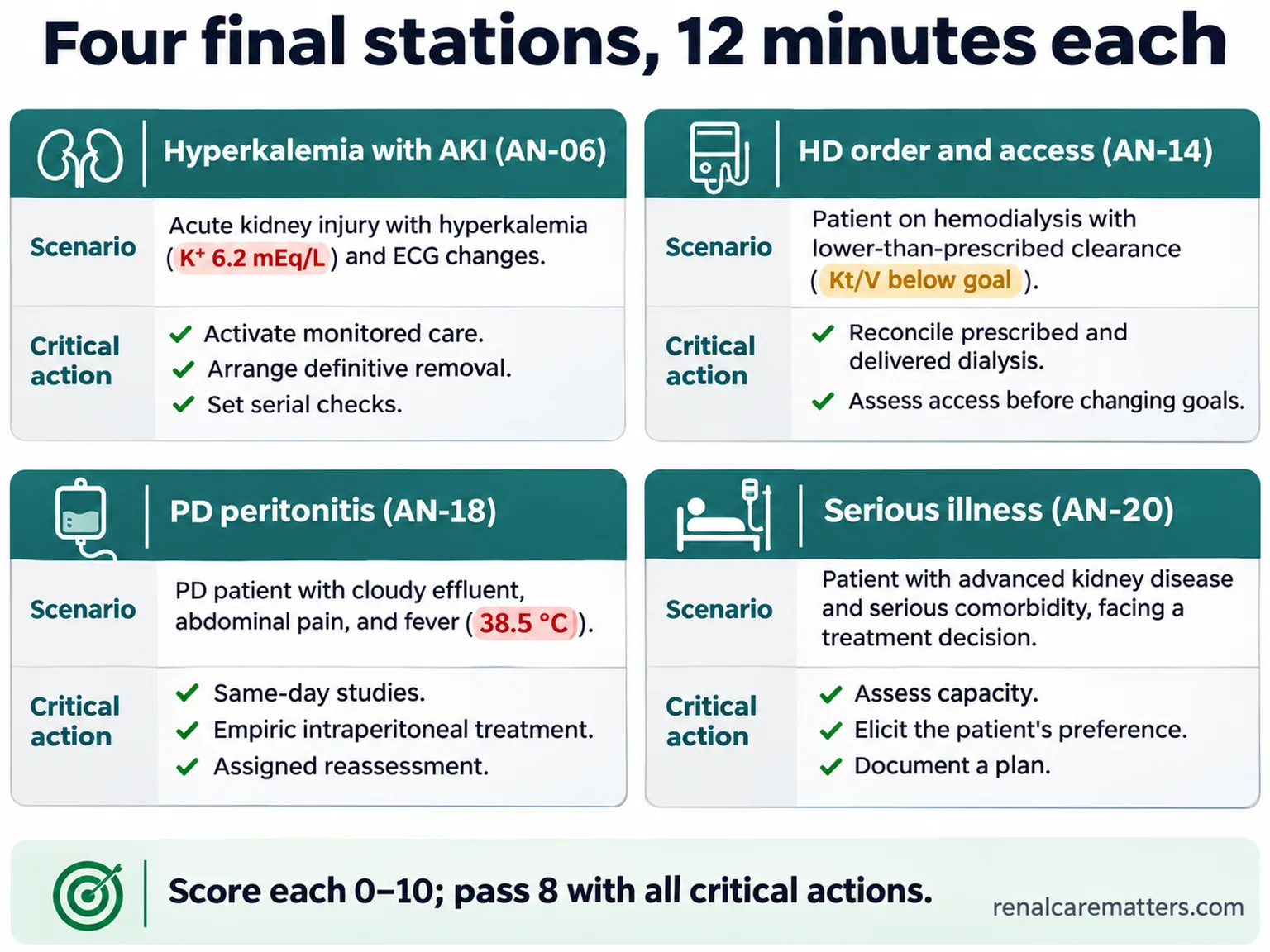
The final assessment is four scenario stations of 12 minutes each, followed by the capstone defense. Score each station 0 to 10; a pass is 8 with every critical action met. A missed critical action means feedback and a repeat with a different case.
Proposed completion criteria
You have finished the Attending Nephrologist track. Your completion is an Academy learning record of self-study. Competence in practice is confirmed separately, by a local assessor who observes your work and by your facility’s credentialing.
Written examination. The end-of-course examination draws 40 questions at random from the question banks of all modules. A proposed pass mark is 80 percent, with missed questions reviewed against their modules before a second sitting. For a supervised sitting, the learner takes it on a unit device with the preceptor present and the preceptor records the score.
Skills checklists for every module
Print this page for a full set. Each checklist starts on a new sheet. Steps marked Critical must all be satisfactory before sign-off; a missed critical step is repeated with the preceptor. Replace any step that does not match your equipment or approved procedure.
Module 1: Taking attending responsibility
Skills checklist. Complete with a preceptor, in simulation or at your own unit. Sign-off is local.
| Observable step | Satisfactory | Needs practice | Not observed |
|---|---|---|---|
| Verifies the credential packet against originals | |||
| Maps a sample after-hours call with time limits | |||
| Confirms backup cover and the accepting pathway in writing | |||
| States which role is acting (attending nephrologist (AN), Medical Director or Clinical Head) |
Learner ____________________ Preceptor ____________________ Date __________
Module 2: The renal consultation and diagnostic dataset
Skills checklist. Complete with a preceptor, in simulation or at your own unit. Sign-off is local.
| Observable step | Satisfactory | Needs practice | Not observed |
|---|---|---|---|
| Reconstructs the baseline with dates | |||
| Personally interprets the urine sediment | |||
| Classifies acute kidney injury (AKI), acute kidney disease (AKD) or chronic kidney disease (CKD) and localizes the lesion | |||
| Writes urgency, plan and result ownership |
Learner ____________________ Preceptor ____________________ Date __________
Module 3: Consultant communication and coverage
Skills checklist. Complete with a preceptor, in simulation or at your own unit. Sign-off is local.
| Observable step | Satisfactory | Needs practice | Not observed |
|---|---|---|---|
| Uses Situation, Background, Assessment, Recommendation (SBAR) or ISBAR and read-back | |||
| Names the reassessment time and fallback | |||
| Documents the receiving clinician | |||
| Uses an approved, privacy-compliant channel |
Learner ____________________ Preceptor ____________________ Date __________
Module 4: Consent, prescribing and medication reconciliation
Skills checklist. Complete with a preceptor, in simulation or at your own unit. Sign-off is local.
| Observable step | Satisfactory | Needs practice | Not observed |
|---|---|---|---|
| Uses teach-back | |||
| Identifies a dose or timing concern by mechanism | |||
| Assigns each pending medication decision an owner and a date |
Learner ____________________ Preceptor ____________________ Date __________
Module 5: Acute kidney injury and post-AKI care
Skills checklist. Complete with a preceptor, in simulation or at your own unit. Sign-off is local.
| Observable step | Satisfactory | Needs practice | Not observed |
|---|---|---|---|
| Stages AKI from trends | |||
| Works up perfusion, obstruction and intrinsic causes in parallel | |||
| Identifies leptospirosis features and starts antibiotics | |||
| Drafts a post-AKI plan with named labs and owner |
Learner ____________________ Preceptor ____________________ Date __________
Module 6: Potassium, sodium and acid-base emergencies
Skills checklist. Complete with a preceptor, in simulation or at your own unit. Sign-off is local.
| Observable step | Satisfactory | Needs practice | Not observed |
|---|---|---|---|
| Recognizes electrocardiogram (ECG) toxicity | |||
| Orders correct calcium and insulin-glucose doses with glucose monitoring | |||
| Assigns definitive removal with a time | |||
| Writes a sodium-correction ceiling and rescue plan |
Learner ____________________ Preceptor ____________________ Date __________
Module 7: Acute kidney replacement and ICU consultation
Skills checklist. Complete with a preceptor, in simulation or at your own unit. Sign-off is local.
| Observable step | Satisfactory | Needs practice | Not observed |
|---|---|---|---|
| Justifies the indication by physiology | |||
| Chooses a modality using hemodynamics and capability | |||
| Confirms access site and location | |||
| Sets daily recovery and reassessment criteria |
Learner ____________________ Preceptor ____________________ Date __________
Module 8: CRRT delivery, special indications and stopping
Skills checklist. Complete with a preceptor, in simulation or at your own unit. Sign-off is local.
| Observable step | Satisfactory | Needs practice | Not observed |
|---|---|---|---|
| Calculates delivered treatment time and dose | |||
| Reviews downtime causes with the intensive care unit (ICU) team | |||
| Confirms a medication review | |||
| States stopping criteria |
Learner ____________________ Preceptor ____________________ Date __________
Module 9: CKD staging, progression and risk reduction
Skills checklist. Complete with a preceptor, in simulation or at your own unit. Sign-off is local.
| Observable step | Satisfactory | Needs practice | Not observed |
|---|---|---|---|
| Documents cause, GFR category, and albuminuria category (CGA) classification and Kidney Failure Risk Equation (KFRE) | |||
| Reviews eligibility for each pillar with reasons | |||
| Assigns affordable follow-up monitoring |
Learner ____________________ Preceptor ____________________ Date __________
Module 10: CKD complications and multidisciplinary review
Skills checklist. Complete with a preceptor, in simulation or at your own unit. Sign-off is local.
| Observable step | Satisfactory | Needs practice | Not observed |
|---|---|---|---|
| Interprets anemia data with inflammation in context | |||
| Interprets serial mineral labs together | |||
| Documents symptom and nutrition goals |
Learner ____________________ Preceptor ____________________ Date __________
Module 11: Glomerular disease and kidney biopsy decisions
Skills checklist. Complete with a preceptor, in simulation or at your own unit. Sign-off is local.
| Observable step | Satisfactory | Needs practice | Not observed |
|---|---|---|---|
| Identifies rapid progression from tempo and sediment | |||
| States biopsy prerequisites and risk in absolute numbers | |||
| Presents a clinicopathologic summary with infection prophylaxis |
Learner ____________________ Preceptor ____________________ Date __________
Module 12: Tubulointerstitial, vascular and inherited disease
Skills checklist. Complete with a preceptor, in simulation or at your own unit. Sign-off is local.
| Observable step | Satisfactory | Needs practice | Not observed |
|---|---|---|---|
| Creates a focused phenotype summary | |||
| Names urgent referral scenarios | |||
| Documents a genetic counseling referral |
Learner ____________________ Preceptor ____________________ Date __________
Module 13: Kidney failure planning and dialysis initiation
Skills checklist. Complete with a preceptor, in simulation or at your own unit. Sign-off is local.
| Observable step | Satisfactory | Needs practice | Not observed |
|---|---|---|---|
| Compares modality burdens in daily-life terms | |||
| Creates a timeline with access and transplant referral | |||
| Documents a shared decision and start triggers |
Learner ____________________ Preceptor ____________________ Date __________
Module 14: Maintenance HD prescription and delivered adequacy
Skills checklist. Complete with a preceptor, in simulation or at your own unit. Sign-off is local.
| Observable step | Satisfactory | Needs practice | Not observed |
|---|---|---|---|
| Reviews a complete order for safety and feasibility | |||
| Identifies a delivery discrepancy and its cause | |||
| Sets a repeat measurement plan |
Learner ____________________ Preceptor ____________________ Date __________
Module 15: HD emergencies and consultant escalation
Skills checklist. Complete with a preceptor, in simulation or at your own unit. Sign-off is local.
| Observable step | Satisfactory | Needs practice | Not observed |
|---|---|---|---|
| Uses a closed-loop call | |||
| Identifies a shared-exposure trigger | |||
| Documents event, actions and disposition |
Learner ____________________ Preceptor ____________________ Date __________
Module 16: HD access and infection prevention
Skills checklist. Complete with a preceptor, in simulation or at your own unit. Sign-off is local.
| Observable step | Satisfactory | Needs practice | Not observed |
|---|---|---|---|
| Examines or describes access findings | |||
| Documents urgency and the infection plan | |||
| Assigns a definitive access review |
Learner ____________________ Preceptor ____________________ Date __________
Module 17: Peritoneal dialysis prescription and home follow-up
Skills checklist. Complete with a preceptor, in simulation or at your own unit. Sign-off is local.
| Observable step | Satisfactory | Needs practice | Not observed |
|---|---|---|---|
| Reviews home logs | |||
| Identifies one modifiable barrier | |||
| Documents monitoring and after-hours contact instructions |
Learner ____________________ Preceptor ____________________ Date __________
Module 18: PD peritonitis and mechanical complications
Skills checklist. Complete with a preceptor, in simulation or at your own unit. Sign-off is local.
| Observable step | Satisfactory | Needs practice | Not observed |
|---|---|---|---|
| Gives the urgent call-back plan | |||
| Specifies studies and the empiric treatment pathway | |||
| Assigns response review and catheter decision dates |
Learner ____________________ Preceptor ____________________ Date __________
Module 19: Kidney transplantation referral and shared care
Skills checklist. Complete with a preceptor, in simulation or at your own unit. Sign-off is local.
| Observable step | Satisfactory | Needs practice | Not observed |
|---|---|---|---|
| Writes a transplant referral with a complete dataset | |||
| Identifies urgent graft red flags | |||
| Confirms transplant-service acceptance and the monitoring plan |
Learner ____________________ Preceptor ____________________ Date __________
Module 20: Conservative kidney management and serious illness
Skills checklist. Complete with a preceptor, in simulation or at your own unit. Sign-off is local.
| Observable step | Satisfactory | Needs practice | Not observed |
|---|---|---|---|
| Uses a values question | |||
| Documents the plan and decision-specific capacity | |||
| Assigns a follow-up contact and review date |
Learner ____________________ Preceptor ____________________ Date __________
Module 21: PhilHealth documentation and ethical claims
Skills checklist. Complete with a preceptor, in simulation or at your own unit. Sign-off is local.
| Observable step | Satisfactory | Needs practice | Not observed |
|---|---|---|---|
| Matches session dates to source records | |||
| Holds the discrepant claim | |||
| Logs the reviewer, correction and result |
Learner ____________________ Preceptor ____________________ Date __________
Module 22: Disasters, outbreaks and service continuity
Skills checklist. Complete with a preceptor, in simulation or at your own unit. Sign-off is local.
| Observable step | Satisfactory | Needs practice | Not observed |
|---|---|---|---|
| Prioritizes by clinical risk | |||
| Names alternate sites and confirms acceptance | |||
| Closes the follow-up list |
Learner ____________________ Preceptor ____________________ Date __________
Module 23: Supervision, evidence appraisal and quality improvement
Skills checklist. Complete with a preceptor, in simulation or at your own unit. Sign-off is local.
| Observable step | Satisfactory | Needs practice | Not observed |
|---|---|---|---|
| Defines numerator and denominator | |||
| Gives behavior-specific feedback | |||
| Drafts a measurement plan with a balancing measure |
Learner ____________________ Preceptor ____________________ Date __________
Module 24: Integrated attending capstone
Skills checklist. Complete with a preceptor, in simulation or at your own unit. Sign-off is local.
| Observable step | Satisfactory | Needs practice | Not observed |
|---|---|---|---|
| Defends initial and maintenance plans | |||
| Demonstrates escalation and handoff to confirmed receipt | |||
| Corrects the claim and proposes a measurable change |
Learner ____________________ Preceptor ____________________ Date __________


