Conservative kidney management and serious illness
Elicit goals, assess decision-specific capacity and share prognosis honestly.
PublishedNailathalaGipatikPepalwal:ReferencesMga SanggunianMga TinubdanReng Reperensya:2Audience: Practicing nephrologists · senior nephrology fellows · internists who share longitudinal kidney care in the clinic, ward, ICU, dialysis unit, and homeRead timeOras ng pagbasaOras sa pagbasaOras ning pamamasa:
Training track for attending nephrologists in adult practice
This module is study material for attending nephrologists and senior fellows in adult practice. It explains the reasoning behind common decisions; it is not a protocol. Doses and thresholds must be checked against current product labels, guidelines, and your institution’s approved protocols. Regulatory and benefit rules change: confirm them on the date of service. Every case is fictional.
Learning objectives
After this module you should be able to
Elicit goals, assess decision-specific capacity and share prognosis honestly.
Build an active conservative care plan or a time-limited dialysis trial.
Document advance care planning and coordinate palliative support.
Pre-testBefore you read, answer the 5 self-assessment questions and note your score. After the module, select New set of questions and compare. The difference is what you learned; the questions you still miss are what to reread.
Start here
The big picture, in plain words
Your duty · Section 1.2, 2024 hemodialysis guidelinesUnder the Philippine Society of Nephrology (PSN) guidelines: Explain every option, including not starting dialysis, and document the decision (b1); plan long-term care with the patient (b9).
In plain wordsFor some older or very frail patients, dialysis adds treatment burden without adding much life. Conservative kidney management is not ’doing nothing.’ It is a different, active treatment aimed at symptoms, function and time at home.
Figure 1 · Key numbers
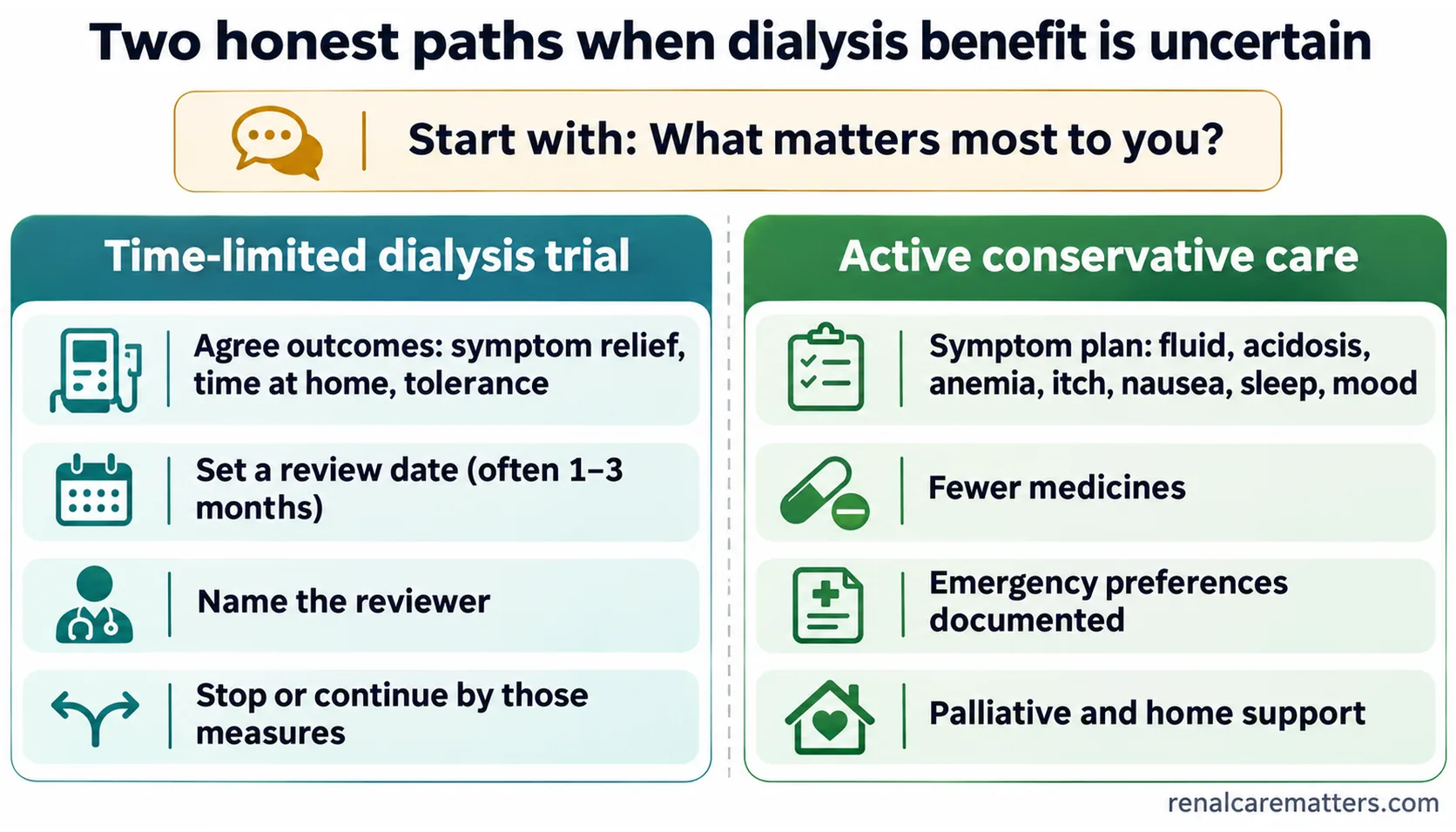
Time-limited trial elementsAgreed outcomes, a review date (often 1–3 months) and a named reviewer
Prognostic promptSurprise question: ’Would I be surprised if this patient died within 12 months?’
Opening case · fictional
Case: “Please decide before you talk to him”
Mr. Pineda, 84, has chronic kidney disease (CKD) G5 and comes to your pre-dialysis clinic in a wheelchair. He has heart failure and had a stroke two years ago, and he spends most of the day in bed. He lives with his daughter in a second-floor apartment.
Before he is wheeled in, his three children stop you in the corridor. “Doctor, we want him on dialysis, three times a week, for as long as it takes. Please decide with us first, before you talk to him. He gets confused and he worries.” In the room, Mr. Pineda tells you he would like to stay home and is not sure the trips to your unit would be worth it.
Before reading on, decide:
Can you make this decision with the family, without him?
What can you honestly tell them about dialysis at his age and frailty?
What are the options, and what will you document?
Keep your answers in mind. The lesson gives you what you need, and the case review near the end shows one sound response.
Lesson · part 1
How it works
With advanced CKD, symptom burden comes from several sources: uremic toxins (fatigue, pruritus, nausea, poor appetite), volume (dyspnea), anemia, acidosis, sleep disturbance and depression. Many of these respond to targeted treatment without dialysis: diuretics, sodium bicarbonate, erythropoiesis-stimulating agent (ESA), antipruritics, dietary protein adjustment and antiemetics. In frail patients, dialysis initiation itself is often followed by functional decline: hospital stays, catheter placement and the physical cost of thrice-weekly travel.
By telemedicine, a conservative care review · fictional
Lola Pacing, 87, chose conservative management. Her daughter sets up a video call because she is itchy all night and has stopped eating breakfast.
You treat each symptom with a specific step: skin care and an adjusted antipruritic for the itch, an antiemetic before breakfast, and a review of her protein intake with the dietitian. Two weeks later she is sleeping again.
What this shows. Conservative kidney management is active treatment of symptoms, not the absence of treatment.
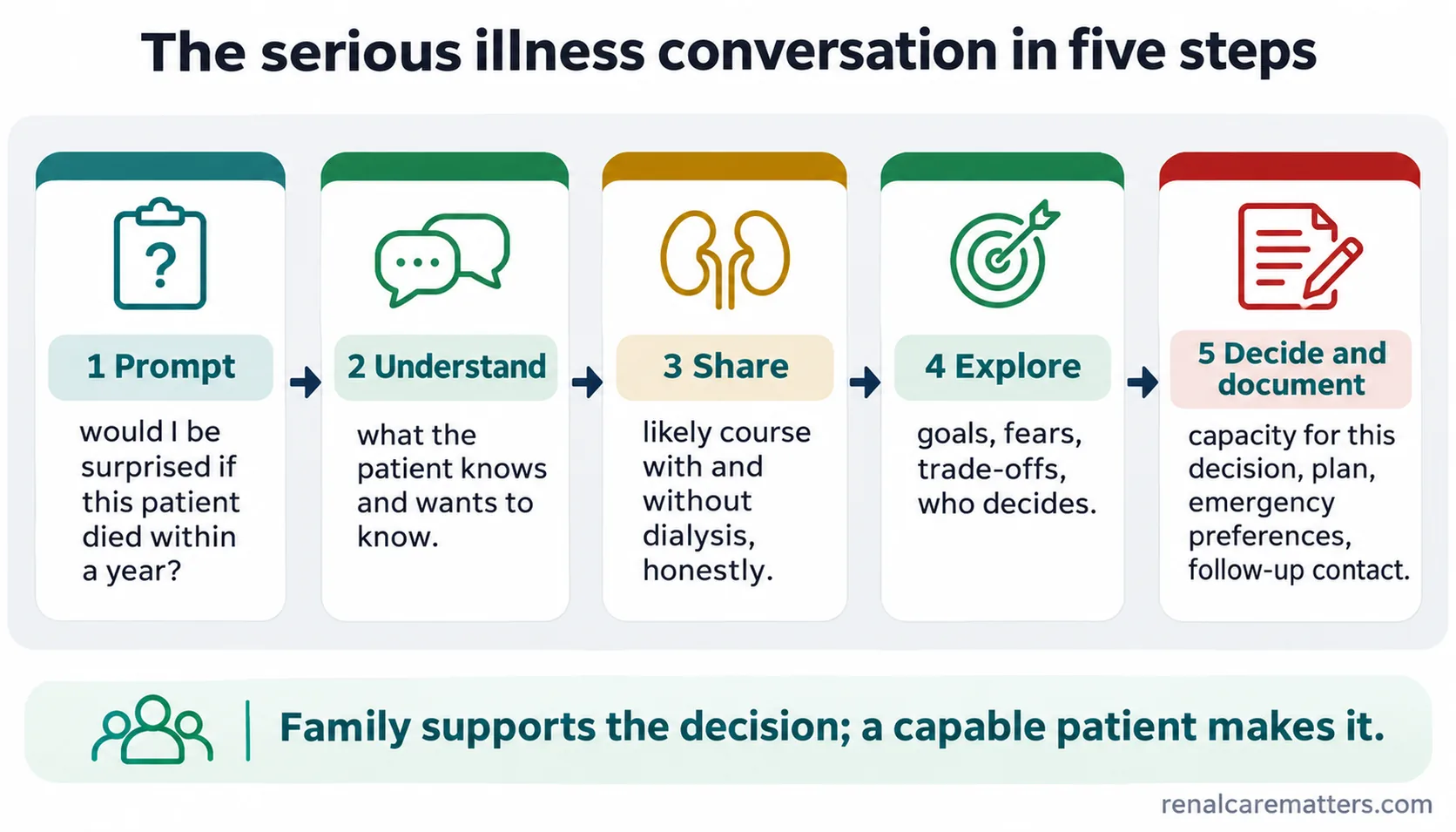
Figure 2. The serious illness conversation in five steps. Five steps for a serious illness conversation about dialysis, from the surprise question to documenting the decision.
Lesson · part 2
What the evidence shows
Observational cohorts of older adults (generally over 75–80 years) with high comorbidity suggest that the survival advantage of dialysis over conservative management is small or absent, while time in hospital is higher with dialysis. These are non-randomized comparisons with strong selection effects, so they inform conversations rather than dictating choices. The Kidney Disease: Improving Global Outcomes (KDIGO) Controversies Conference on supportive care (2015) and the KDIGO 2024 CKD guideline support offering conservative kidney management as an informed choice, integrated with symptom management and advance care planning. Validated symptom tools (for example IPOS-Renal) help structure assessment.
Ask the ’surprise question’ (would I be surprised if this patient died in the next year?) to prompt the conversation. Explore what matters most to the patient, share likely trajectories with and without dialysis, and assess capacity for this specific decision. Offer an interpreter and include family as the patient wishes. If dialysis is uncertain, offer a time-limited trial with agreed outcomes (symptom relief, time at home, tolerance) and a review date. For conservative management, write an active symptom plan, review medication burden, document emergency preferences and arrange palliative care and home support.
Figure 3. Two honest paths when dialysis benefit is uncertain. Two acceptable paths: a time-limited trial of dialysis with agreed goals, or active conservative care focused on comfort and time at home.
The time-limited trial · fictional
Mr. Pineda agrees to a 2-month trial of hemodialysis. You write three measures with him: whether he still has energy to sit with his grandchildren, how many days a month he spends in hospital, and whether he finds the travel bearable. You set a review date and name yourself as the reviewer.
At the review, he has spent 9 days in hospital and is exhausted after each session. He chooses to stop, and the palliative team visits that week.
What this shows. A trial without measures and a date is not a trial.
Stop and call
Family requesting decisions be made without the patient
Capacity uncertain for the decision at hand
Uncontrolled symptoms on either pathway
No documented emergency plan
On the floor
Real situations: problems and solutions
These are fictional but typical. For each one, cover the answer, decide what you would do, then compare. Where a step depends on local rules, your unit’s procedure and your supervisor’s direction come first.
The trial with no review date
What you see
A frail patient started a “trial” of hemodialysis six months ago; nobody has reviewed it.
What is likely going on
A time-limited trial without a review becomes indefinite.
What to do
Hold the review now with the patient and family, using the agreed measures.
Why it matters
A trial needs an end point written at the start.
Uncontrolled itch at home
What you see
A patient on conservative management cannot sleep because of itching.
What is likely going on
Uremic pruritus.
What to do
Treat it actively: skin care, adjusted medicines, and review by the palliative team.
Why it matters
Conservative care is active treatment, not the absence of treatment.
The emergency room at 2 a.m.
What you see
A patient on conservative care is brought to the emergency room, and the team starts preparing a dialysis catheter.
What is likely going on
His wishes were never documented where the emergency team could see them.
What to do
Make sure every patient on conservative care has an emergency plan that the family carries.
Why it matters
An undocumented choice is easily overridden in a crisis.
Field notes
Ask the surprise question.
Assess capacity for the specific decision.
Offer an interpreter when needed.
Write an active symptom plan.
Case review
Back to the case: “Please decide before you talk to him”
Without him? No, and you can say so kindly. The decision is his unless he lacks the capacity to make it. Assess his capacity for this specific decision, not for everything. Being confused at times does not remove it. Offer to meet with him and the family together.
What you can honestly say. Ask the surprise question privately: would you be surprised if he died within the next year? Then explain the likely course on each path. In observational studies of older adults with many illnesses, mostly over 75 to 80, dialysis added little or no survival compared with conservative care, and patients spent more time in hospital. These are not randomized comparisons, and the patients who chose dialysis differed from those who did not, so present this as what is known about people like him, not as a prediction for him.
The options. Conservative kidney management is active treatment: diuretics for breathlessness, bicarbonate, anemia treatment, medicines for itch and nausea, and palliative care at home. The other option is a time-limited trial of hemodialysis with agreed measures, such as symptoms, time at home, and how he tolerates the travel, and a review date one to three months away. Document his capacity, his preference in his own words, his emergency wishes, and who will follow up, and give the family a number to call.
Skills lab · with your preceptor
Skills checklist: Skills checklist
Complete with a preceptor, in simulation or at your own unit. Sign-off is local. Your preceptor rates each step as satisfactory, needs practice, or not observed. Steps marked Critical must all be satisfactory before sign-off. This checklist supports supervised learning; your unit’s own procedure and competency form are the authority. A printable version of every checklist is on the trainer page.
Uses a values question
Documents the plan and decision-specific capacity
Assigns a follow-up contact and review date
Placement activity. Simulation or supervised practice
Self-assessment
Check your understanding
Each visit draws 5 questions at random from this module’s 5-question bank. Choose the single best answer for each, then select Check answers; an explanation appears under the best answer. Select New set of questions for a different mix. A good target is 4 of 5 on two different sets. Nothing you select is sent anywhere; scoring happens in your browser.
Kidney Disease: Improving Global Outcomes (KDIGO) CKD Work Group (2024). KDIGO 2024 clinical practice guideline for the evaluation and management of chronic kidney disease. Kidney International, 105(4S), S117–S314. https://doi.org/10.1016/j.kint.2023.10.018
Educational material for physicians. Completing it is an Academy learning record only. It does not confer CPD units, PSN certification, privileges, or PhilHealth accreditation, and it does not replace current guidelines, regulations, your institution’s protocols, or clinical judgment.